

Fresno is the largest city in the United States within just over an hour’s drive of three national parks – Yosemite, Kings Canyon and Sequoia. A fourth, Pinnacles, is just two and a half hours away. For Fresno State students, that means access to some of the most unique class, research and leisure experiences surrounding any college campus in the world.
Often referred to as Fresno’s backyard, the natural wonders of these national parks offer Bulldogs plenty of space to play.
The mountainous peaks, breathtaking canyon views and overwhelmingly large trees are as much a part of the Central Valley’s identity as agriculture. As the gateway to these national parks, the Central Valley is represented by Fresno State’s Green V symbol, a reminder of the people and places in the region the university so proudly represents.
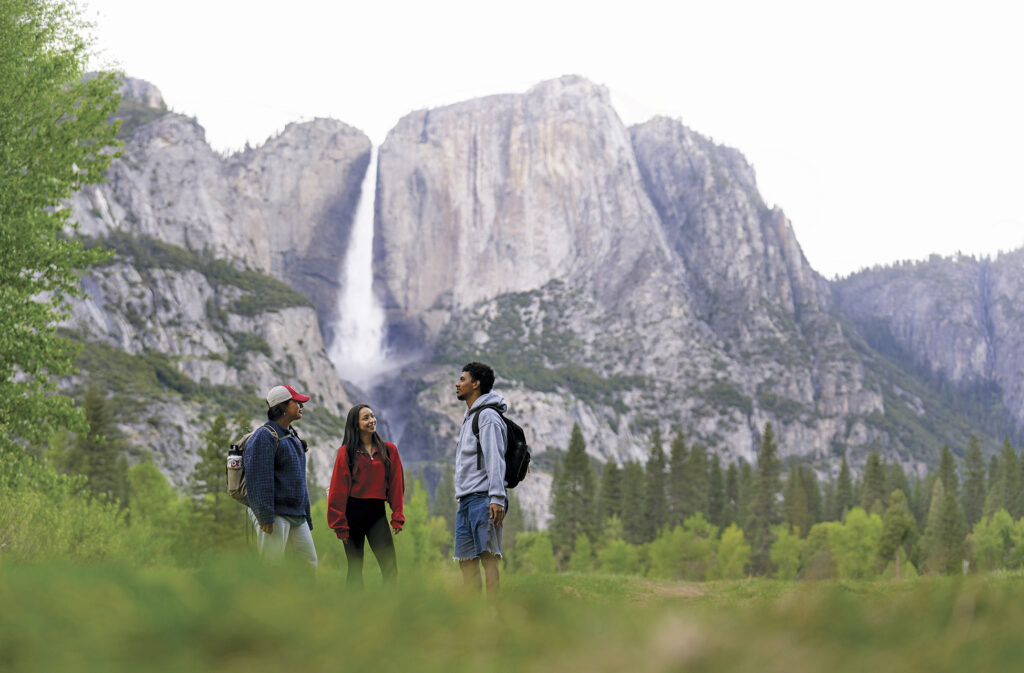
Millions of people from around the world travel to visit these national parks every year – and there’s a growing effort to make sure Fresno State students aren’t taking their close proximity for, ahem, “granite” (get it?).
Fresno State’s proximity to so many natural wonders – the mountains, trees and canyons of national parks (and yes, beaches too) – is a recruiting pitch few campuses can match.
“As an alum, one of the most underrated parts of the experience was how close you are to places like Yosemite,” said Jenna Mills, a 2005 graduate who is now director of global corporate communications at Impact.com. “It wasn’t something you had to plan weekends in advance. On a random weekend, or even
a free afternoon, you could just decide to go. That kind of proximity makes adventure feel spontaneous and accessible, not like a big production.”
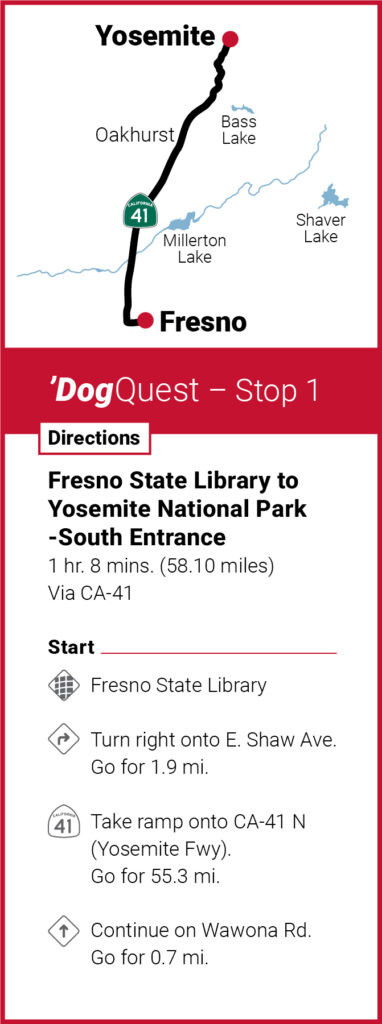
Welcome to Yosemite National Park
Much like the giant granite wonders naturally carved into its landscape, Yosemite helped carve the path for the United States’ national park system. President Abraham Lincoln signed the Yosemite Grant in 1864, establishing the precedent of federal land preservation for public enjoyment. Yosemite’s wilderness was designated as a national park in 1890 following the advocacy of John Muir.
Home to the world-famous Half Dome and El Capitan granite peaks, visitors are treated to nearly indescribable views when they emerge from the tunnel on their way toward Yosemite Valley.
Yosemite is home to 25 named waterfalls, including Yosemite Falls, the tallest waterfall in North America at 2,425 feet. In February, Horsetail Fall on El Capitan glows at sunset as if it’s on fire, a phenomenon known as Yosemite Firefall.
“Yosemite National Park is probably the crown jewel of all the national parks in our country,” said Fresno State instructor Daniel Suvanto. “It’s perfect any time of year. Wintertime, there’s snow. Summertime, you can just jump in the river. It’s paradise. People travel here from all over the world and it’s just so crazy that our students are able to wake up in their own bed and make it to Yosemite before lunch.”
Suvanto and the students in his REC 87 course, “A Yosemite Experience” loaded into the College of Health and Human Services’ Bulldog-branded 12-passenger van along with one of the students’ personal vehicles and left the Fresno State campus about 7 a.m. on Oct. 17, 2025. Just over an hour later, they entered Yosemite National Park.
Their first stop was the Mariposa Grove, featuring a giant sequoia tree that visitors can walk through. The park is also home to the Fallen Tunnel Tree, a giant sequoia with a seven-foot hole that vehicles could drive through until it fell during a snowstorm in 1969.
For some students, this was their first time visiting Yosemite. For others, this one-unit course was an excuse to go back.
Students in REC 87 only meet twice throughout the semester – once for a class meeting to go over details, and again on the day they travel to Yosemite for an overnight camping trip.
The Yosemite experience gives students a chance to venture outside their comfort zone, bond with peers and challenge themselves to try new things. “These are the types of classes that make a university a university,” Suvanto said.
And they are the types of classes Fresno State is uniquely positioned to offer.


The class was Keanu Xayaphonesongkham’s first time tent camping in Yosemite. He was joined by his girlfriend Makayla Payne, a grad student pursuing a master’s in general experimental psychology. It was her first time ever visiting Yosemite.
The students enjoyed Suvanto’s guided hikes and exploration deep in the Yosemite wilderness, a campfire with creative would-you-rather questions and even a snowball fight.
Despite the chill in the air, Xayaphonesongkham ended up shirtless and fully submerged in near-freezing lake water, yelling out with his fists clenched as he reacted to the cold temperature. “You know how people do ice baths?” he said, “that was my intention.”
Xayaphonesongkham, a psychology major, said REC 87 is one of the most memorable classes he has taken. As a child, he said he became a heavy gamer after his parents got him an Xbox and “video games were my adventure.” But when he was a student at Sunnyside High School in Fresno, his family started traveling more and he visited the mountains for the first time, near China Peak.
“I spent a lot of hours wishing for adventure,” he said.
This camping trip in Yosemite was filled with it. “I was a little nervous about spending the night out there,” Xayaphonesongkham said. “I’m in a tent, and I took clothes out of my bag and built a nest to stay warm. Suvanto was sleeping outside, he was just chilling, and it was so much colder.”
Suvanto, a 2014 Fresno State alumnus, is a manager at MetalMark Climbing in Fresno, an indoor climbing and fitness gym. His goal in teaching the course is to remove any barriers that would keep students from visiting and help them feel comfortable and supported.
“If you’re not outdoorsy, that’s totally fine. I’ll help you with it. I’m going to help you set up your tent. If you don’t have the time, it’s literally one weekend. You got it. I’ll help you with your math homework. There’s no excuse to not take one of these courses.”
Xayaphonesongkham agrees. “Experiences like that help students stay in school.”
→ Native Land
There are several American Indian tribes with ancestral ties to Yosemite National Park, including the Southern Sierra Miwuk Nation, Bishop Paiute Tribe, Bridgeport Indian Colony, Mono Lake Kootzaduka’a, North Fork Rancheria of Mono Indians of California, Picayune Rancheria of the Chukchansi Indians and Tuolumne Band of Me-Wuk Indians. The Ahwahneechee are the Indigenous people of Yosemite Valley.
Welcome to Sequoia National Park
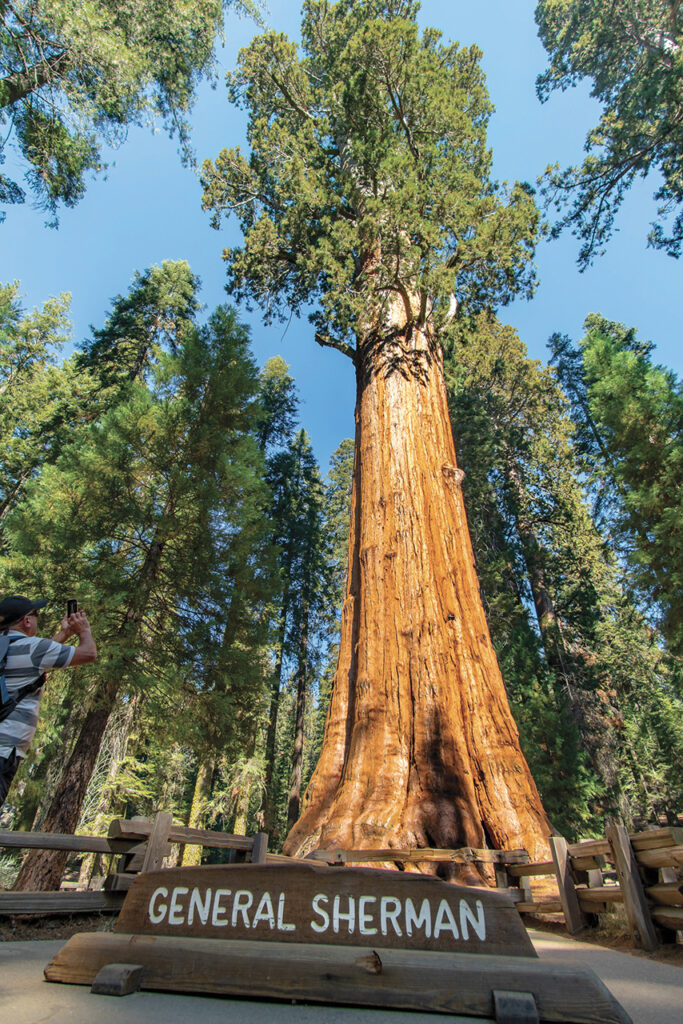
When it comes to big trees, Sequoia National Park is home to some true giants. Established in 1890, Sequoia is the second-oldest national park and the first created to protect a living organism – the giant sequoia tree.
Sequoia National Park is home to the General Sherman Tree, the world’s largest living tree by volume at 275 feet tall with a base circumference of more than 100 feet. The tree is about 2,200 years old and weighs an estimated 4.1 million pounds. Found inside the park, the “Land of Giants” forest includes five of the 10 largest trees in the world.
Crystal Cave is one of 275 marble caves inside the park, and the popular Moro Rock is a granite dome offering panoramic views of the Great Western Divide, with summits reaching over
13,000 feet high.
Above all else – literally – the park is home to Mount Whitney, the highest point in the lower 48 states at 14,505 feet.
And it’s all within a park about an hour-and-40-minute drive from the Fresno State campus.
Fresno State’s REC 88 course, “Rock Climbing,” introduces students to outdoor adventure in a fun and supportive environment – with unforgettable views for those who make it to the top.
This year, students in the one-unit course climbed Crystal Wall, a granite cliff popular for climbers. It’s the perfect blend of challenging and doable for the many students who are trying rock climbing for the first time, under the direction of Ryan Soares, the recreation administration lecturer at Fresno State who leads the course.
“It was beautiful, oh my gosh, it was amazing,” said Jarilyn Weaver, a liberal studies major who was climbing for the first time. “I kept telling myself I have to make it to the top, I’m not going to start and not finish. You feel so safe the entire time. I’m really glad they have this at Fresno State.”
For some students, the class ignites a new passion, or even a career direction. “In the years that we’ve been teaching this class, we’ve had multiple students who have changed their trajectory as a result of this class,” Soares said. “We’ve had students get into climbing and want to become a part of that industry. We’ve had students change their major because of a spark that was ignited here and seeing the possibilities in themselves and what’s out there in the world.”
Even for those who don’t want to pursue climbing as a hobby or career, the experience can be significant.


“It kind of reminds me of a lot of other factors in my life like exams or even personal stress, work stress,” said Roxana Jarrahian, a business technology major. “Despite the pain and everything telling you you can’t do it, it’s about pushing through and getting to the top because everything is possible, and you can do anything. Being able to do this experience and climb a rock has been relatable to other experiences in my life, and I think it’s made me stronger.”
Similar to other experiential courses, REC 88 meets just twice during the semester – once for a lecture and
once on the day of the trip. Despite just a few meetings, these courses create lasting bonds between the students who overcome a challenge together.
“It feels unreal,” Jarrahian said. “It’s really great that I have a supportive group of people that are always supporting, always pushing. I don’t know if I would have ever done something like this if it wasn’t for my college offering this and feeling comfortable, feeling motivated.”
→ Native Land
Several American Indian tribes have ancestral ties to Sequoia and Kings Canyon national parks, including the Western Mono (Monache), Yokuts, Tubatulabal, Owens Valley Paiute and Western Shoshone.
Welcome to Kings Canyon National Park
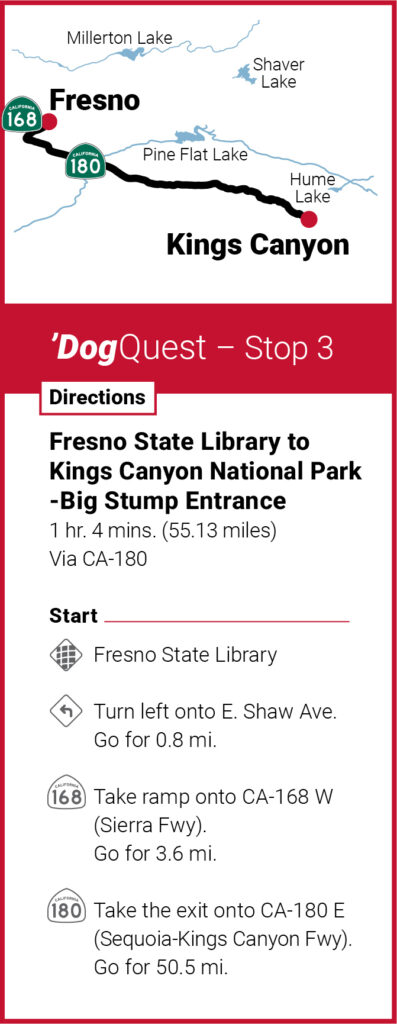
If depth is what makes a canyon grand, then Kings Canyon National Park is the grandest of all. At 8,200 feet deep, Kings Canyon is the deepest river canyon in the United States, about 2,200 feet deeper than the Grand Canyon in Arizona.
Established as a national park in 1940, Kings Canyon is also home to the General Grant Tree, the second-largest tree in the world. Designated as the Nation’s Christmas Tree on April 28, 1926 by President Calvin Coolidge, the giant sequoia is over 1,800 years old, 268 feet tall and has a diameter of 33 feet at its base. To this day, a Christmas service and wreath-laying ceremony is held at the tree each year on the second Sunday of December.
In 1956, President Dwight D. Eisenhower declared the tree a national shrine, the only living object to receive such designation, in memory of service members who fought and died for the nation’s freedom.
Grant’s Grove features a half-mile loop trail with a dozen giant sequoia trees, plus many more in the surrounding forest. Visitors can also walk through the Fallen Monarch, a giant, hollowed-out sequoia that fell more than 300 years ago.
Kings Canyon National Park is located just north of Sequoia National Park. Though each is distinct, the adjacent parks are jointly managed, sharing a border and a single entrance fee.
In 2025, ecologist Ann Huber of the National Park Service connected with Fresno State associate biology professor Dr. Katherine Waselkov on a project to update and digitize about 8,000 plant specimens for the Sequoia-Kings Canyon Herbarium. Huber had previously visited the Fresno State Herbarium, which houses about 40,000 specimens.
Through grants to support the project, five Fresno State research assistants completed the project in the spring 2026 semester. The students worked diligently with specimens that require special handling – they have to be frozen before and after processing to ensure insects don’t damage the specimens, many of which are decades old, some dating back to the 1930s.
“It’s really important we have a historical record of plants and versions of plants over time because you can examine morphology and have a record of plants that have gone extinct,” said Tess Aaron, a junior biology major from Chowchilla who is focusing on ecology and botany. “Digitizing is important because it’s available to the public and remotely available to researchers, including plant locations and plant populations.”
The students applied a barcode on each sample, put it in a light box to capture an image and used software to process and upload each specimen into a shared database for all California herbaria. This allows researchers and the public to access valuable scientific information on when and where plants were found, what was around them and what type of habitat they lived in.
“We have quite a few research opportunities for undergrads,” Waselkov said. “I think the CSU system as a whole does a great job of offering research experience for undergrads. There are a lot of undergrads in our labs doing the research we want to get done and also doing local research to make a difference in our community and tie us together to the region.”
Students like Aaron, Andrea Laine and Jose Camarena, who were heavily involved in the project, each enrolled in BIOL 190 for research credit. Many of Waselkov’s students have also taken BIOL 125, “Plant Taxonomy,” in which they collected and handled plant specimens for the Fresno State Herbarium.
“The students understand the importance of this. It seems like bureaucratic stuff, but it’s really important to have historical records to see where things have grown over time,” Waselkov said. “Because of climate change, we are expecting things to grow and flower at different stages. We can also locate rare species and where they occur in the national parks.”
Both Aaron and Laine said they are always on the lookout for rare species when processing the specimens. But sometimes it is difficult to know which ones are rare just by looking at them. “I usually look up pretty ones or really colorful ones because it’s interesting to see those that are really green or retain color so well,” said Laine, a pre-med student who is originally from Rosamond in Kern County.


When the students visited the national park in February for a hike with plant ecologist Sylvia Haultain, they observed cones from a white bark pine. Though the tree is federally listed as a threatened species, it is common at high elevations in both Kings Canyon and Sequoia.
Waselkov said experts predict flowering time will change in a lot of species with warming and drying occurring earlier in the year, which can lead to mismatches with insects that partner with certain plants.
“Ecosystems are going to change in terms of which species live where,” she said. “Some plants might go extinct in certain ecosystems or move higher up the mountains. People who study plants are expecting to see those changes, but we need historical data to study that. This information is now available online because of the students’ research.”
Waselkov joined the Fresno State faculty in 2015 after earning her doctoral degree at Washington University in St. Louis. She is originally from Alabama. “There is a really high diversity in plants here. I come from a really flat place so it’s nice to be able to follow the bloom up the mountains,” Waselkov said.
“Fresno is an ideal place for teaching about plants. There are so many places we can drive to in a short amount of time. You’ve got the Sierras, foothills, coast, vernal pools, alkali sinks, wetlands and Mojave Desert.”
Waselkov said every friend or family member who comes to visit her wants to go to the national parks. “A lot of them want to go to Yosemite, but I always say, ‘let’s go to Kings Canyon instead.’ If you drive into the canyon in the area past Grant’s Grove, it’s really spectacular.”
With so many beautiful and truly breathtaking sights, everyone has a favorite – or soon will upon visiting. The key is encouraging Fresno State students to take advantage of their close proximity to the national parks, which is what more and more classes on campus are designed to do.
“We’re such a big place with access to so many national parks near Fresno,” Aaron said. “In much of Fresno there’s not much green space, so it’s really cool we have close access to natural spaces. It’s not just cities and cities and cities from hundreds of miles out.”
For students, alumni and community members alike, adventure is just a short drive away. So open up that map app. Chances are, something extraordinary is right here in our own backyard.
✐ Get schooled on the national parks
Fresno State classes introduce students to activities, research and experience at Yosemite, Kings Canyon, Sequoia National Parks and beyond
AMERICAN INDIAN STUDIES
College: College of Social Sciences
Courses:
- AIS 5: American Indian History
- AIS 103: California American Indians
- Description: Students learn about the formations of tribal societies, systems of governance and traditional ecological knowledge while exploring connections to the Central Valley. The courses evaluate the living relationship between tribes and their homelands, cultures, land and water stewardship and more.
ANTHROPOLOGY
College: College of Social Sciences
Courses:
- ANTH 103: Archaeological Site Survey
- ANTH 128: Environmental Anthropology
- ANTH 145: Cultural Resources Management
- Description: Courses in the Department of Anthropology provide an in-depth examination of historic cultural resources, their significance and management in the U.S. Students get an introduction to archaeological survey methods, preparing them for careers in cultural resources management and archaeology. Students also learn about interactions between the environment and human culture, and examine the conservation and the development of national parks and forests, fire ecology and the traditional and ecological knowledge of Indigenous tribes.
BIOLOGY
College: College of Science and Mathematics
Courses:
- BIO 167: High Altitude Biology
- Description: The course is a combination of field lectures and discussions surrounding the biology of plants and animals that thrive at higher elevations as well as general outdoor, environmental exposure. The one-day trips are primarily training trips to get the students used to hiking longer distances with heavy packs (including first-time hikers and campers/backpackers).
COMMUNICATION
College: College of Arts and Humanities
Courses:
- COMM 130: Environmental Communication
- COMM 135: Communication of Science and Technology
- Description: Students examine communication about the environment, focusing on ways that corporations, governments, scientists and citizens describe, persuade and shape human interactions with the environment. In COMM 135, students read a chapter from Dr. Robert Lull’s new book, “Our Natural Lab,” featuring 71 different national parks (see “Around the Parks” section). The chapter details the psychology of awe while looking at Yosemite and the Grand Canyon.
EARTH AND ENVIRONMENTAL SCIENCES
College: College of Science and Mathematics
Courses:
- EES 3: Geology Field Trip
- EES 50: National Parks of the Sierra Nevada
- EES 114: Engineering Geology
- Description: From a field-investigation course exploring California’s diverse landscapes; to a course investigating the geology, ecology and natural human history of the local national parks; to a course applying geological principles to engineering projects, Fresno State’s Department of Earth and Environmental Sciences provides numerous opportunities for students to gain hands-on, experiential learning while visiting Yosemite, Kings Canyon and Sequoia national parks, as well as Death Valley and the California coast.
MEDIA, COMMUNICATIONS AND JOURNALISM
College: College of Arts and Humanities
Courses:
- MCJ 157: Public Relations and Advertising Agency
- Description: This unique course functions as if students work for an agency serving a real client. Recent classes worked with the National Park Service in Yosemite to promote wildlife education. Past campaigns focused on bear safety, water safety, fire safety and prescribed burns. Students learn from National Park Service professionals and get opportunities to ask questions and strategize to reach their target audiences and communicate their client’s desired messaging in a memorable way.
RECREATION ADMINISTRATION
College: College of Health and Human Services
Courses:
- RA 55: Foundations and Careers in Recreation, Parks and Tourism
- RA 80: Lifelong Learning in the Natural Environment
- REC 82: Wilderness Survival
- REC 86: Backpacking the Sierra Mountains
- REC 87: Yosemite Experience
- REC 88: Rock Climbing
- RA 145: Environmental Interpretation
- RA 146: Adventure-Based Programming
- RA 192T: Nature Rx
- Description: Perhaps the area that most takes advantage of Fresno State’s proximity to the national parks, the Department of Recreation Administration offers a variety of courses that make experiencing the national parks both accessible and challenging in unforgettable ways. Foundational courses include those offering the philosophical, theoretical and historical foundation of recreation service, and exploring the social, psychological and physiological benefits of nature-based learning. Students are exposed to national parks in a way that helps them identify personal skills as they try new things. Students can take classes in which they’ll stay overnight for a Yosemite experience (see page 18); go rock climbing in Sequoia-Kings Canyon (see page 20); or learn wilderness survival skills covering fire building, shelter construction, signaling and land navigation while exploring the way people react to crises. There is something for a student in any major offered within the Department of Recreation Administration.
CONTINUING AND GLOBAL EDUCATION
- Field trip for international students
- Description: Though not an official class, the Division of Continuing and Global Education at Fresno State offers field trips to expose international students to the natural wonders surrounding the region. In April, students were treated to a trip to Yosemite, ensuring they had a chance to visit the national park that drew over 4 million tourists in 2025, about 400,000 of which were from foreign countries.
𖠰 Around the parks
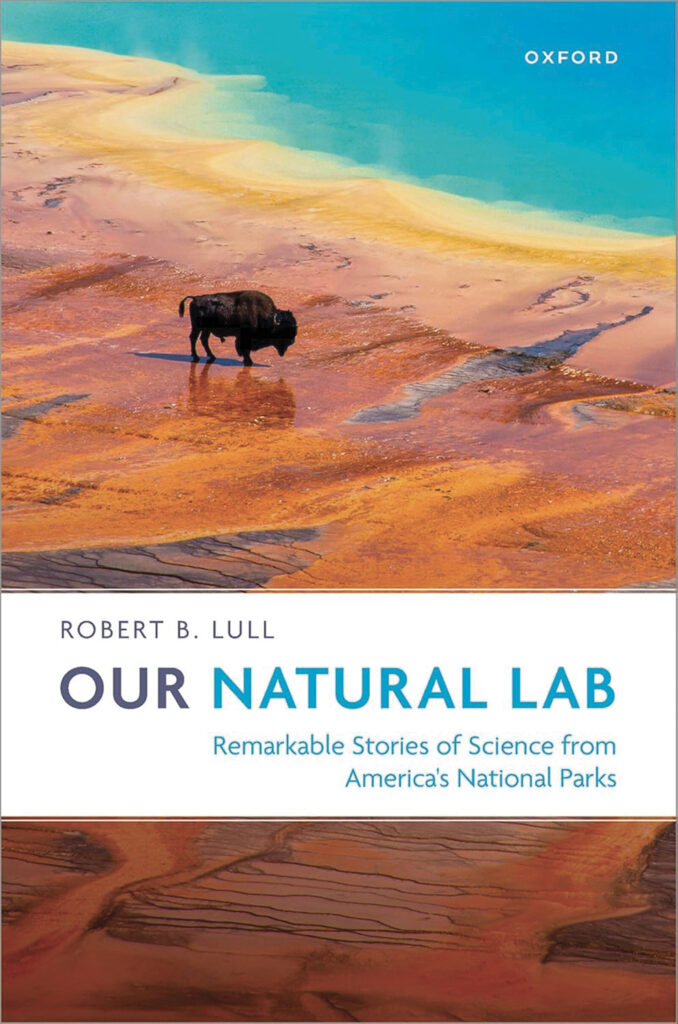
History of National Park Research
Dr. Robert Lull, an associate professor of science communication at Fresno State, authored a book titled “Our Natural Lab: Remarkable Stories of Science from America’s National Parks,” which was published this year.
Pivotal to science, technology and health history, the book includes stories of lead contamination research from a remote Yosemite canyon and a half century of extreme environment research in Yellowstone’s hot springs that launched the biotechnology industry.
“What’s crystal clear from these stories is that national parks aren’t just places where routine science occurs, but also essential settings for some of science’s most important breakthroughs over the last 150 years.”
Read the full story on Lull’s book and the research behind it.
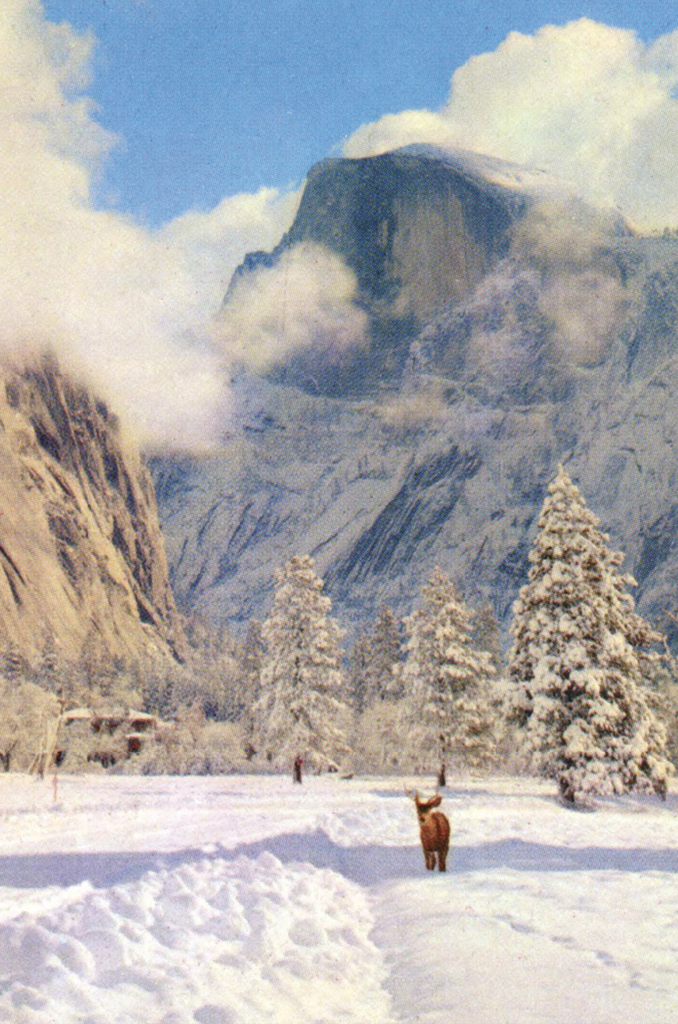
Woodward Californiana Collection
Want to learn more about the history of the national parks surrounding the Central Valley region? The Fresno State Library houses the Roy J. Woodward Californiana Collection with books, photos, historical newspaper clippings and more. In fact, the collection was one of the research sources for this magazine story.
Woodward (1878-1940) was a prominent Fresno businessman who owned an impressive collection of books on California history. In 1950, his collection was donated to the Fresno State Library by his grandchildren, O. James Woodward III, Beverly Woodward, Barry O’Connon, Ramona Walker and Patricia Ronald.
His collection led to the creation of the Special Collections Research Center at the library and is used by students and the public.
Written by Eddie Hughes (‘05); Photos by Cary Edmondson (‘03); Video by Jeff Phillips (‘11)