
Every parent knows the quiet weight of being watched, the small eyes studying their every move. For Victoria Lee, that gaze became her anchor.
Through long commutes, late-night homework, bringing her laptop to her daughter’s extracurriculars after school and moments when exhaustion felt heavier than hope, she kept going for the one person who believed in her long before she believed in herself – her daughter.
“Some days, I don’t want to be resilient anymore,” she admitted through tired laughter, “but then I remember, she’s watching. And she deserves to see what’s possible.”
1 in 5: A student-parent’s fight for visibility
Lee’s story was born in the Central Valley, shaped by immeasurable challenges and yet deeply rooted in hope. Her connection to mental health runs deep, and her goal is to build a future where others can access the support she once desperately needed.
Her dream? To one day create programs that uplift those facing struggles similar to those she experienced – a way to transform her hardest chapters into someone else’s lifeline. Reflecting on her past, Lee shared that she became pregnant with her daughter at a young age, while unhoused and struggling with addiction.
“I remember a police officer and a nurse who each, at different points in my life, noticed when I was in distress and made an effort to assist me. I will always remember them,” she said. “Being in my current situation…it feels surreal to have reached this point, as, despite the doubts of many, I still persisted and showed them I could succeed with my daughter by my side.”
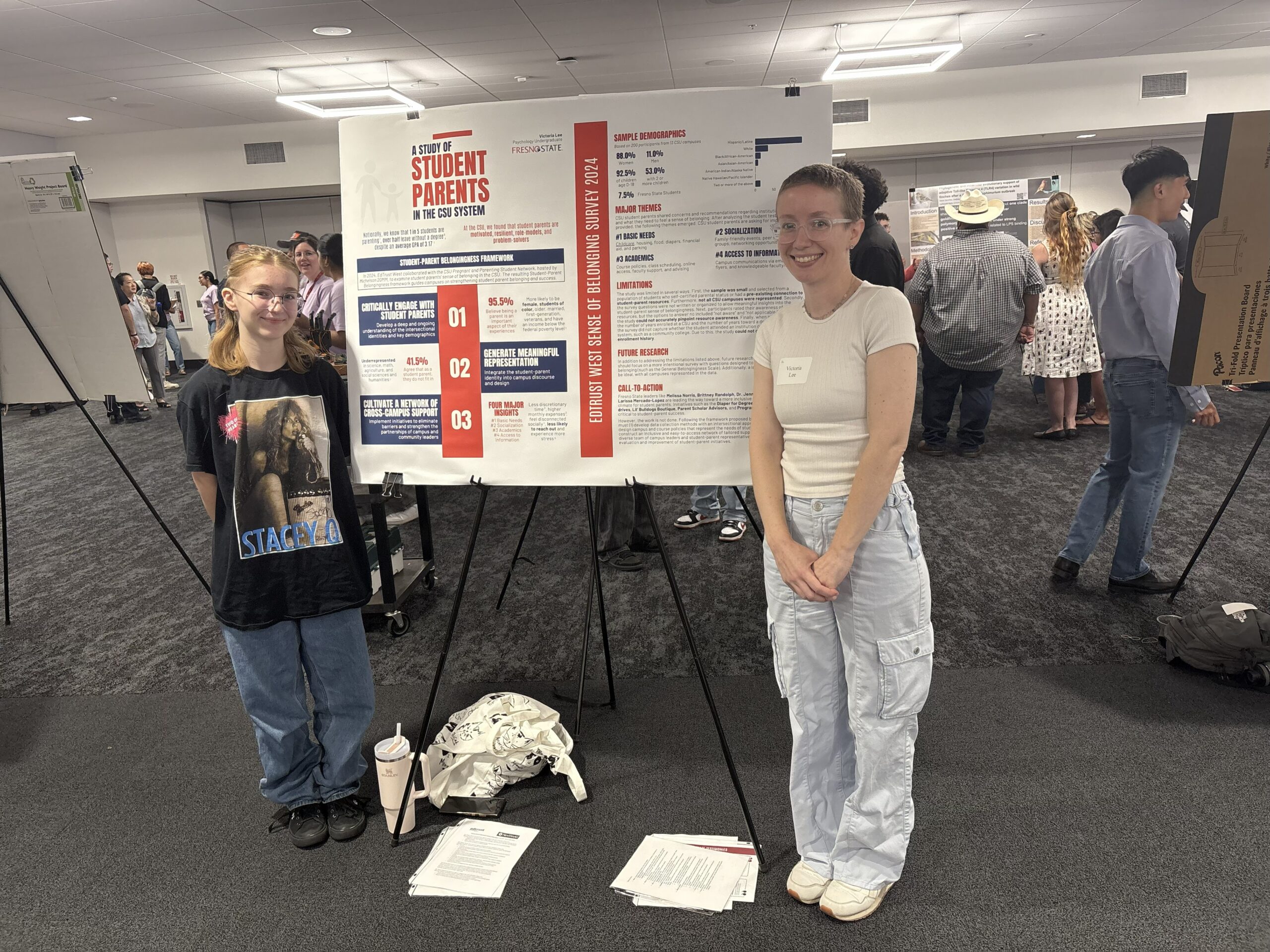
Lee, a psychology major and parent-scholar, is part of an often invisible community on college campuses. A report by the California Alliance for Student Parent Success estimates 1 in 5 college students in the U.S. is a parent, yet over half leave without a degree, despite earning an average GPA of 3.17.
Based on Lee’s summer 2025 research, which included 200 participants from 13 California State University campuses, student-parents reported overwhelming challenges:
- 41.5% said they often feel they don’t fit in, noting that parents would like to see the integration of the student-parent identity into campus discourse and design.
- 95.5% believe that being a parent is a crucial aspect of their life experiences.
- CSU student-parents shared concerns and recommendations in the following areas to strengthen and improve: Basic needs, socialization, academic support (such as better class scheduling and advising), and improved access to information that can support students and their dependents/families.
“We know that there are certainly more students who are also parents, whom we just haven’t connected with yet. I constantly ask myself, ‘Where are they, and how do I find them?’” she said.
But the student feedback also showed something else, something that felt deeply familiar to Lee: Student-parents are problem solvers who are motivated and resilient, and they are dedicated to their children and their futures.
“Seeing the statistics made me feel validated,” Lee said. “We’re not falling behind. We’re doing everything we can, and somehow excelling, even if it takes us years to get our degree(s).”
Finding belonging by creating it
When Lee first arrived at Fresno State, she struggled to find her footing. Between full-time work, parenting alone, a long commute back to Paso Robles and classes stacked at the end of each day, she felt isolated until she joined the Student Health Advisory Committee.
“[The committee] changed everything,” she said. “I finally felt like I was contributing to something bigger.”
The committee wasn’t just a meeting room of students, she said, it was a place where her lived experience mattered. She helped design health campaigns, advocated for student needs and contributed to meaningful change. It was the first time she felt her Fresno State experience expand beyond survival.
Then came the Parent Scholar Advisors, a group of student-parents brought together to advise campus leaders and support other parents navigating the college experience. For the first time, Lee felt she wasn’t the only one balancing childcare schedules, online coursework and dreams that demanded more hours than the day allowed.
“When we sat in those meetings, I didn’t have to explain why something was hard,” she said. “Everyone already understood. That kind of community is priceless.”
Where research meets possibility
Lee’s research, conducted with Dr. Larissa Mercado-Lopez, chair of the Department of Women’s, Gender and Sexuality Studies at Fresno State, revealed the need for change within the CSU: more family-friendly policies, more accessible course options, improved communication and spaces where student parents feel acknowledged and supported.
Her advocacy work reflects her belief that classrooms should be the first place where student-parents feel welcome, not the last on the priority list.
“Why shouldn’t we feel proud to be student-parents?” she asked. “Why shouldn’t we feel like we belong here?”
Lee also participated in a summer research program, STEAM: Enriched Pathways, noting that support from Dr. Christopher R. Meyer, dean of the College of Science and Mathematics at Fresno State; Dr. Joy Goto, associate dean; and the office staff was pivotal to the success of her undergraduate career and the research she conducted.
“They made a huge difference in my experience at Fresno State as a student-parent. The research I conducted was only possible because the colleges that hosted it had created an opportunity for me to get involved in research, but I couldn’t balance it during a regular semester. They made space for me and my needs by encouraging me to bring my daughter anytime I needed or wanted throughout the program. It is really why I am so involved in student-parent advocacy now.”
Fresno State leaders across campus are supporting student-parents through initiatives like diaper distribution through the Parent Scholars Program, the Lil’ Bulldogs Boutique, Parent Scholar Advisors and Programs for Children.
Graduation: The big moment
When she imagines walking across the stage at the College of Science and Mathematics commencement from 1:15 to 3:15 p.m on May 15, the emotions come quickly.
“It’s surreal,” she said softly, pausing to wipe a few tears. “It’s not just my achievement. It’s ours. My daughter, my wife… they’re the reason I made it here.”
The statistics Lee once analyzed now feel personal. She defied the odds. She became the story she hoped to read. She became the example her daughter deserved.