

Dr. Kerry McBee spent nearly two decades investigating fires and failures involving electrical systems. Now, the Fresno State associate professor of electrical and computer engineering has patented a monitoring system to identify power-line hazards before they spark wildfires.
The U.S. Patent and Trademark Office issued a patent for McBee’s Overhead Fire Prevention System in July. The Real-Time Overhead Autonomous Monitoring System, or ROAM System, continuously monitors overhead electrical equipment and is designed to detect deteriorating power lines and other hazards weeks or even months before they could cause a fire or power outage.
“Right now, much of what a utility does is reactive,” McBee said. “This would be a proactive prevention system because it could prevent the fire from ever occurring.”
Before joining Fresno State, McBee spent 17 years in the electrical and fire industry. As a forensic engineer and certified fire and explosion investigator, he investigated more than 1,500 fires involving electrical systems and led major investigations across 10 states.
That experience led him to recognize a gap in how power lines are monitored.
“Utilities monitor the electrical attributes, but they don’t necessarily monitor the physical condition of the system,” McBee said. “That made me wonder whether we could build a system that identifies physical deficiencies before they lead to a failure.”
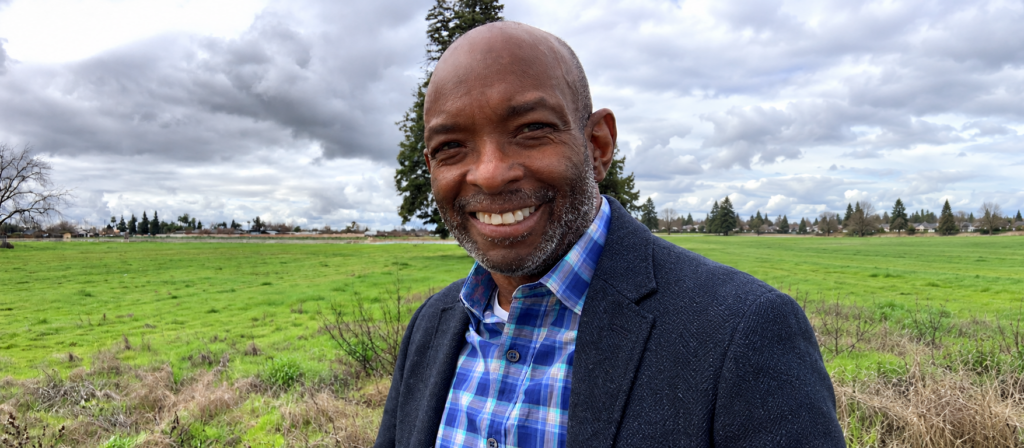
Before working in higher education, McBee served in the U.S. Marine Corps during Operation Desert Storm and later worked as an industrial maintenance technician. Still feeling like he was missing something, he enrolled at the Colorado School of Mines at age 27 to pursue an engineering degree.
After graduating, he studied power engineering at Rensselaer Polytechnic Institute, focusing on power system failures. He later worked as a forensic engineer before joining Xcel Energy, where he spent 12 years investigating failures and helping design one of the nation’s first modernized smart grids.
While working as an engineer, McBee also taught as an adjunct faculty at the Colorado School of Mines and discovered a newfound passion.
“After two years of teaching, I realized I enjoyed teaching engineering more than I enjoyed my daily engineering position,” McBee recalled. “So I went back to school part-time. In the daytime, I was an engineer. At night, I was doing research for my Ph.D. and once I finished, I was able to get a tenure-track position in the Lyles College of Engineering at Fresno State in 2016.”
Building on that foundation, McBee began developing the fire prevention technology in 2021 and applied for a patent in 2023 with support from Fresno State’s University Patent Board. The board reviews inventions developed by faculty, staff and students; evaluates their patent and commercial potential; and helps determine the rights and financial interests of the parties involved.
“The larger goal is to translate ideas and discoveries developed at Fresno State into practical technologies, products, and businesses that contribute to economic growth and benefit our community,” said Dr. Jason Bush, associate vice president for Research and Sponsored Programs at Fresno State. “The applied nature of Dr. McBee’s technology, its potential real-world impact and possible commercial interest made it an attractive invention for the university to support and advance.”
The California Energy Commission recognized the ROAM System’s real-world potential by awarding a $150,000 CalSEED grant to inRG Solutions, LLC, a company McBee founded to develop and commercialize the fire-prevention technology.
As part of his research, McBee created a database examining the causes, fatalities and property damage associated with 25 of California’s deadliest and most destructive wildfires. He used his findings to help design the system.
Primarily intended for remote areas where deteriorating power-line equipment can be difficult to inspect regularly, the technology could also help prevent unplanned power outages in urban areas.
“What really makes it different is that it monitors a number of physical characteristics,” McBee said.
An onboard neural network, a form of artificial intelligence, analyzes data collected by the system’s sensors to identify conditions that could lead to a wildfire.
McBee and his collaborators have tested the technology in controlled environments and are now developing a market-ready version. In the coming months, he plans to build an outdoor field laboratory with mock overhead power lines to further test and refine the prototype.
They also hope to establish pilot programs with utility companies such as Pacific Gas and Electric Co. and Southern California Edison.
“Our goal is to validate it from a market standpoint and prove how valuable it is to the industry,” McBee said. “It’s inexpensive to install, and it has the potential to save millions of dollars in property damage and ultimately save lives.”
Since filing the patent in 2023, McBee has continued developing the system with help from engineering students who have contributed research and ideas, including improvements to its communication capabilities. He intends to involve students in the technology’s next phase.
For McBee, the patent marks a significant milestone in a journey spanning more than two decades, both personally and professionally.
“It means quite a bit,” McBee said. “It feels like the culmination of years of investigating, studying and researching failures. It is very satisfying to see all of that experience come together in this system.”