
In late 2011, a team of U.S. Army soldiers in the mountains of Afghanistan near the Pakistan border was heading back to their base in a particularly dangerous area when gunshots rang out.
“One of my buddies got shot,” said retired Staff Sergeant Nathan Tomshack, a Fresno State graduate student.
Immediately, Tomshack and the team medic began working on the soldier who was fighting for his life.
“The medic was amazing; got him back to life six times.”
Sadly, the soldier later succumbed to his injuries on the helicopter.
While dragging his buddy to a point where a helicopter could pick him up, a rocket-propelled grenade exploded nearby, sending shrapnel into Tomshack’s leg. In the moment of battle, adrenaline had taken over, keeping the pain at bay, and he carried on.
“Someone came up to me and was like, ‘Sergeant Tomshack, how are you walking?’”
Looking down, he recalls seeing a large piece of metal sticking out of his leg and a lot of blood.
“Then I felt it.”
The injury ended Tomshack’s deployment in Afghanistan, his third combat tour since joining the Army in 2007. His previous two combat tours were in Iraq, where, in 2010, an improvised explosive device caused his vehicle to roll over, resulting in back injuries.
After spending time in Germany to treat his leg, Tomshack made a final deployment to Djibouti, Africa, where he trained foreign troops. In 2014, after about seven years in the Army, Tomshack was honorably and medically discharged.
With the echoes of battles still ringing, Tomshack returned home to Layton, Utah, north of Salt Lake City, and began working in car sales. With his leg injury, he found it difficult to walk in the snow, so he moved to California. Trying to keep his mind off combat, Tomshack dove into his work, which he says contributed to the loss of his first marriage.
“What I did instead of reaching out for help was just work 80 to 100 hours a week, trying to basically run from the trauma,” Tomshack said.
At first, he struggled to find a therapist who could relate to his experiences as a soldier in combat, but he eventually found one in Visalia.
“The biggest blessing was meeting with a therapist who started guiding me down the right path and making it easier to be able to talk about the trauma that I had experienced.”
After “floating around,” Tomshack landed in Fresno and, in 2019, began his educational journey at Clovis Community College before transferring to Fresno State, where he earned a bachelor’s degree in exercise science with the goal of becoming a physical therapist.
The call
Just before he graduated, Tomshack got a phone call from his best friend, a veteran he served with in Iraq. His friend was depressed and talked about possibly completing suicide.
“All I can say is…’Oh, man, I’ll get a plane ticket in the next couple of weeks. I’ll come out. I’ll go see you. We’ll hang out.’ Thinking I did the right thing,” Tomshack recalled. “That night, he took his own life. Having to fly out there, hug his daughters and speak at his funeral was tough.”
The experience shook Tomshack, and he vowed that it would be the last time he wouldn’t know what to do.
Turning tragedy into a personal goal and professional calling, he returned to Fresno State for his master’s degree, shifting his focus from physical therapy to mental health and enrolled in the marriage, family and child counseling graduate program. Through the program, Tomshack focuses on learning to help veterans and their families navigate the unique traumas and challenges faced by members of the armed services.
At the heart of his training is the Fresno Family Counseling Center. To earn his degree, Tomshack immersed himself in 600 hours of supervised work — balancing 300 hours of direct therapy with another 300 hours of clinical training and documentation.
“The professional growth of our students during their 600 hours of internship experience is tremendous,” said Dr. Kyle N. Weir, director and clinical faculty of the center. “They start at Fresno Family Counseling Center, focusing on how to serve clients. They need the faculty to watch each session through our technology and give feedback halfway through. Gradually, they become more confident and begin to focus more on how to implement theory, enhance their diagnostic skills and develop greater clinical proficiency.”
Fresno State students being integrated into the Fresno Family Counseling Center is a unique feature of the program that is not found at many other universities.
“Each time the marriage, family and child counseling program goes through accreditation, the reviewers have consistently commented on how unique Fresno Family Counseling Center is in the nation,” Weir said. “Our graduates are highly sought after by community employers because they know how to do so many things at a level most other recent graduates just don’t know. Our students just get more depth and breadth in their training than in other programs.”
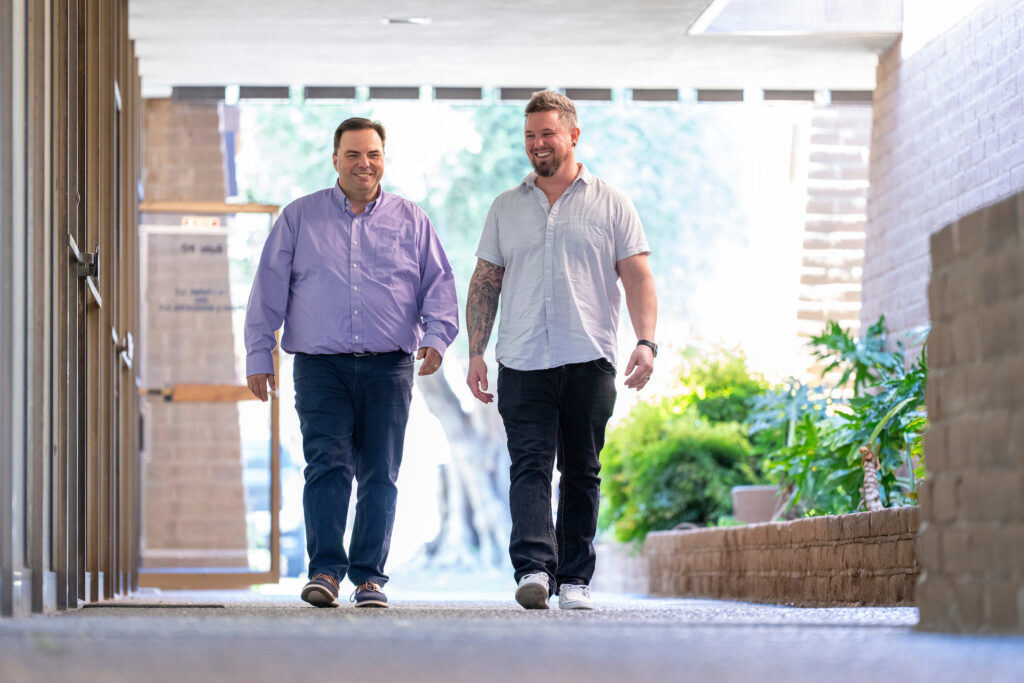
Beyond student training, the center serves as a vital resource for the Central Valley, offering mental health care to underserved communities on a sliding fee scale. The community impact is sustained through grants, contracts and faculty who dedicate their time to supervising the next generation of therapists.
Once students graduate, they can carry up to 700 hours toward the 3,000 hours of supervised professional experience required to take the state test to be a fully-licensed therapist.
“Nate’s experience as a combat veteran is a huge benefit. He understands how to work with trauma. The Central Valley needs more therapists who know how to work with veterans, first responders and others who’ve faced life-threatening dangers and survived. Nate has been a magnet drawing people with trauma – who are often hesitant to get therapy – into clinical services,” Weir said.
While his initial focus was on treating trauma, Tomshack came to appreciate the importance of couples and children counseling.
“I still love trauma work with individuals, but I really have grown,” said Tomshack. “I believe that somebody heals from trauma with support around them. And I believe that that trauma does leak into the rest of the family. So, finding a way to bridge that gap, to get everyone understanding and healing together, makes it more of a team effort rather than an individual struggle.”
Family and a new home
In 2020, Tomshack met his wife, Esme.
“I was at Woodward Park with my daughter, and my wife and her kids walked up, and we just started talking,” Tomshack said. “Our daughters are almost the same age, so they started playing, and we started talking. And then our daughters always wanted to hang out, and we all started hanging out after that – me and her, her son and my daughter and her daughter – and the rest is history.”
They married in 2023.
Even while managing a family, graduate school and a caseload of 15 to 20 clients per week, and dealing with chronic pain from his injuries, Tomshack finds time to volunteer with several local veterans’ organizations, including the Fresno Vet Center and Beyond the Barracks.
Tomshack’s passion and dedication to helping veterans caught the attention of Operation Finally Home, Beyond the Barracks and Lennar Homes, who teamed up to build him and his family a custom, mortgage-free home to accommodate his battlefield injuries. He was chosen for the gift in recognition of his military service and his continued commitment to fellow veterans as a civilian.
Another call
While studying at Fresno State, Tomshack received another call from Mario Alamillo, a friend he had served with in Iraq. Alamillo was at a low point in his life, didn’t know who to trust and was struggling with harmful thoughts.
But this time, Tomshack was better equipped. He had the clinical tools to recognize the crisis and the resources to intervene. He offered to send him money to put gas in his car so he could come to Fresno and get help.
“And so he did. I sent him some gas money. He put it in his car. He drove here.”
When he arrived, Tomshack found out Alamillo had been unhoused for the past year and a half.
“Because of the education I’ve got going through this program and then the support of the community, as I reached out and found things, we were able to put him up in a hotel for two months. I was able to help him find resources around town,” Tomshack said.
Now, Alamillo has moved into an apartment, is going to barber college and works as a barber. He was also able to reunite with his fiancée and three children, who had separated during his crisis.
“Nate is one of those genuine, caring and selfless types of people. No matter what, he tries to help out a lot of people,” Alamillo said. “He’s a good guy to have in your corner and just a good guy to have as a friend. Period.”
Tomshack will walk across the stage at the Kremen School of Education and Human Development’s commencement ceremony to receive his master’s in marriage, family and child counseling at 6:30 p.m. Friday, May 15, at the Save Mart Center.
Following graduation, Tomshack plans to complete the 3,000 hours of supervised professional experience required for his state licensing and continue his work treating trauma survivors and their families.
For Tomshack, the walk across the Save Mart Center stage isn’t just a personal victory; it’s a promise kept to the brothers-in-arms he left behind — and a new beginning for the families he’s now prepared to help heal.
If you or someone you know is struggling with mental health or suicidal ideation, there are resources available:
National Suicide and Crisis Lifeline: 988 or 800.273.8255
Central Valley Suicide Prevention Hotline 888.506.5991
Crisis Text Line: Text “Home” to 741741