

When biologist Jovana Benavides started graduate school, she was just looking to get ahead at her job, not break new scientific ground. But her award-winning master’s thesis project discovered insect species previously unseen in the Valley and holds the promise of creating a powerful new tool in mosquito control.
Benavides received her master’s degree in biology this past May with her thesis “Exploring the Role of Geosmin from Streptomyces Exfoliatus and Kitasatospora Purpeofusca in Attracting Gravid Aedes Aegypti in Urban Settings,” which received the 2026 College of Science and Mathematics Award for Distinction in Student Research.
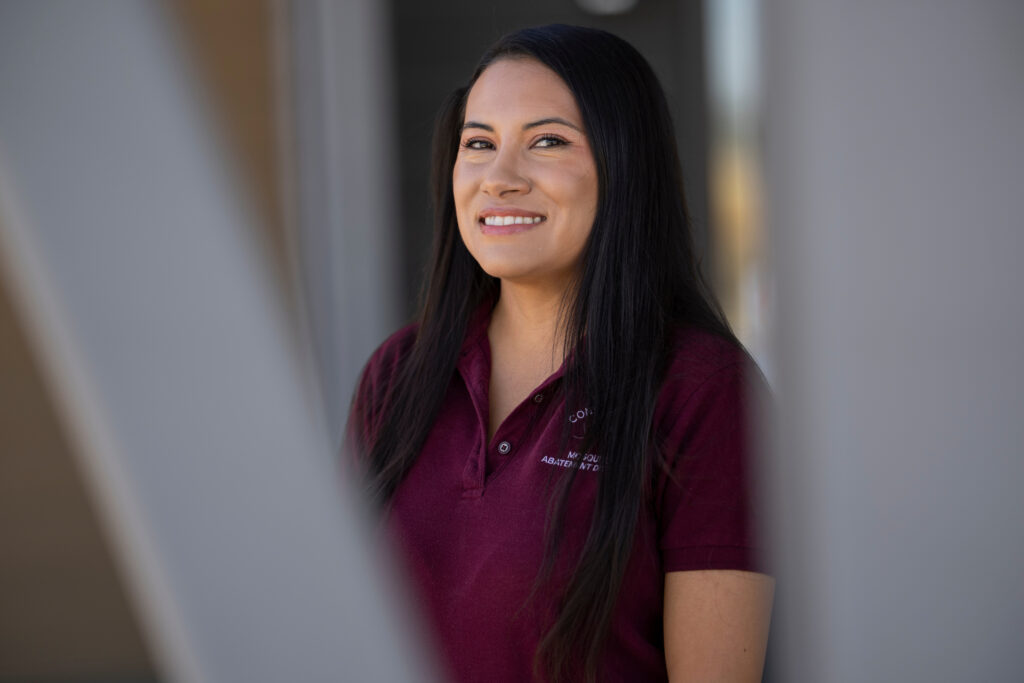
Her research grew out of her work as a vector biologist for the Consolidated Mosquito Abatement District, which is in charge of controlling mosquito populations over most of Fresno County. Benavides manages a team of field technicians that traps mosquitoes and tests them for blood-borne diseases that pose major threats to public health.
“Vector-borne disease is a huge issue in the Valley,” Benavides said. “West Nile virus is endemic to our area. We have imported cases of Zika and chikungunya. We’re in a race right now to find novel ways of attracting and trapping these mosquitoes, because we’re trying to prevent person-to-person transmission. As of now, in Southern California there is person-to-person transmission of dengue fever, and we don’t want that to happen in the Valley.”
Benavides’ research sought to develop better, cheaper and more environmentally friendly methods to trap mosquitoes for disease tracking. She invented a new kind of trap that uses bacteria to produce a natural mosquito-attracting compound. Her research results show her method is effective, but it needs greater refinement to work in the field. But her traps produced an unexpected bonus – catching insects new to researchers.
“One of the most unexpected things that came out of Jovana’s research was that she caught species that had never been caught or described in any detail in the Central Valley,” said Dr. David Lent, associate professor of biology and Benavides’ thesis adviser.
A long, indirect path to graduate studies
Benavides did not originally plan to be a research scientist. She earned a bachelor’s degree in biology from Fresno State in 2017 with the intention of becoming a pharmacist, but after working an internship with a pharmacy, she realized it wasn’t the field for her. Needing a job, she applied for the Consolidated Mosquito Abatement District, where she has been ever since. There, she distinguished herself by developing the district’s first program to monitor mosquitofish.
“To be perfectly honest, it’s a really dirty job working with mosquitofish,” Benavides said. “Some days, I was shoveling dead fish out of a tank. It’s not the most glamorous or prestigious job out there. But I wanted to learn as much as possible. I’m going to be the best at my job. I’m going to be the best at shoveling these dead fish, if that’s what my job is today.”
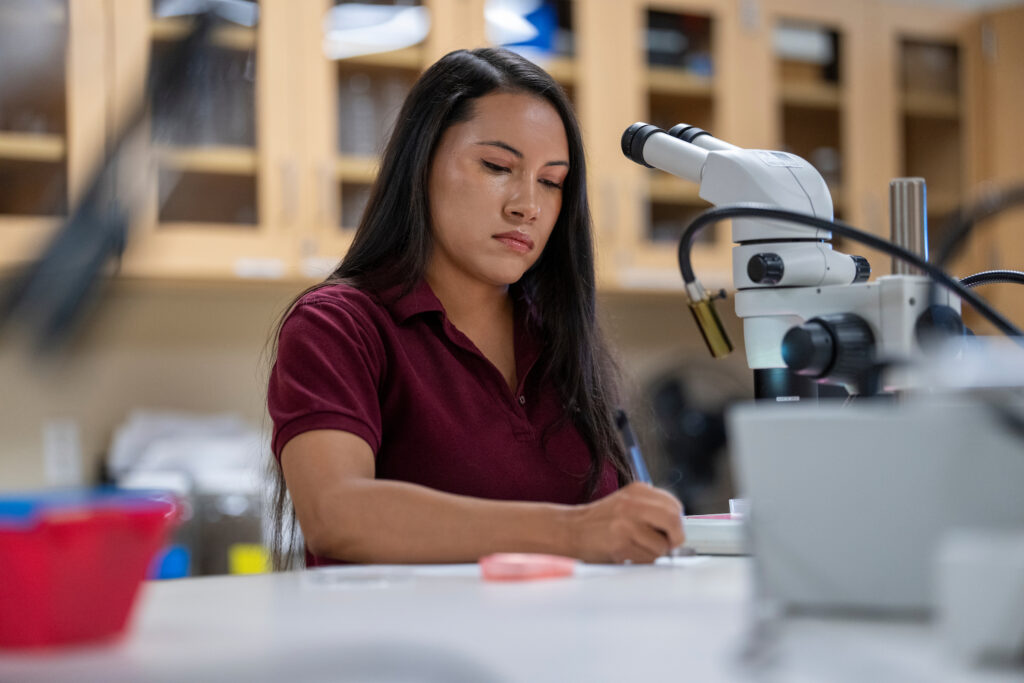
After five years at the mosquito abatement district, Benavides realized a graduate degree would give her the research background to achieve more at her job, but it had been a long time since college, and she was concerned her academic skills were rusty.
“I was very hesitant, because I felt like I’d been away from academia so long,” Benavides said. “I wanted to make sure I excelled in this environment. I reached out to Dr. Lent, and he encouraged me that grad school would help with my professional development.”
Lent said graduate school is not just for academics. Graduate studies can also be a smart move for professionals who want to develop their knowledge and career experience.
“I tailor my mentorship and students’ education plans to students’ end goals, and not every student is going to be an academic and teach,” Lent said. “Students have their own career goals, and I want to do my best to prepare them for that.”
Building a better mosquito trap
Benavides’ goal was to develop knowledge and skills that would make her better at her job. Her employer was supportive of her advancing her education, offering her a flexible work schedule and allowing her to conduct research at her work site. For her thesis project, she wanted to improve mosquito abatement.
“The target species for my research is the Aedes aegypti mosquito,” Benavides said. “I know it’s weird, but this is my favorite mosquito. It’s an invasive species here. There’s a lot of research that needs to be done with Aedes aegypti, because it’s a vector for so many things: yellow fever, dengue, chikungunya, Zika, all these horrible diseases.”
Vector biologists like Benavides track these diseases by sampling pregnant female mosquitoes. Pregnant mosquitoes have recently fed on blood, which can be extracted and tested for viruses. Luring and trapping these mosquitoes can be a challenge.
“As of now, there’s nothing on the market that specifically attracts Aedes aegypti mosquitoes, because they’re very finicky,” Benavides said. “If you use a container that smells too much like plastic or chemicals, they’re repelled by that. If they smell bleach or cleaning material, they’re repelled by that. Their olfactory senses are very sensitive, and not a lot is known about that, because no one really cares about how the mosquito’s olfactory senses work. A lot of the research is focused on how to kill them.”
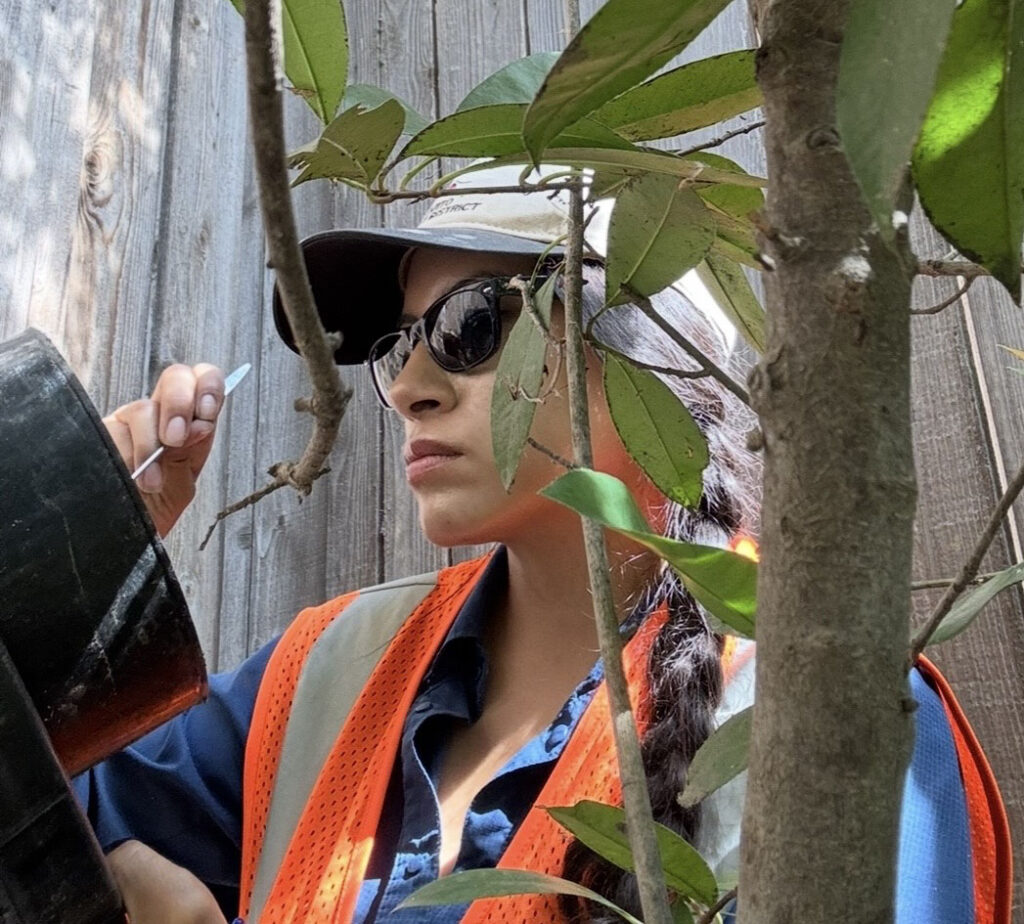
Benavides wanted to find a natural compound that would attract mosquitoes without offending their sensitive noses. She attended a webinar that mentioned mosquitoes were drawn to a chemical compound called geosmin.
“Geosmin is known as the smell of wet dirt,” Benavides said. “After the rain, you smell that really fresh, earthy smell. That’s geosmin you’re smelling. But geosmin is extremely expensive. For about 30 milligrams, it’s about $300 to $400.”
Benavides thought if she could find a natural source for geosmin, she would have a safe, nontoxic and less expensive solution.
“My idea of not using a chemical-based attractant is to have minimal impact on the environment, along with less cost,” Benavides said. “I wanted to do something more natural, because in an urban field trial, I want it to be safe. If we put this trap in somebody’s yard and their cat touches it, they’re going to be completely all right. I want this to be something any mosquito control district can use, and they don’t have unlimited funds. If we can use something cheaper than pure geosmin, this can be utilized throughout the United States.
Benavides initially focused on extracting geosmin from beetroots, mushrooms and carrots, but Dr. Francine Arroyo, a microbiologist and a member of Benavides’ thesis committee, suggested using bacteria that naturally release geosmin.
Arroyo obtained bacteria samples for Benavides that proved to be effective in lab trials for attracting Aedes aegypti. Benavides designed and built traps that incorporated live bacteria in a growth medium and placed them at about 160 field sites. The work was grueling, with Benavides spending long hours in the lab and checking her field test sites on top of her regular work.
Results both disappointing and amazing
Although the geosmin-producing bacteria proved effective in the lab, making the traps work in a field test was more challenging.
“The results, unfortunately, were a little all over the place,” Benavides said. “We realized that when you enter the field, contamination happens very quickly. If a resident is putting fertilizer on their yard, that gets on the bacterial lure, so we had a lot of weird contamination. In the field tests, we did attract Aedes aegypti. But if the lure was contaminated, we caught drastically less Aedes aegypti and we caught more nontargeted species.”
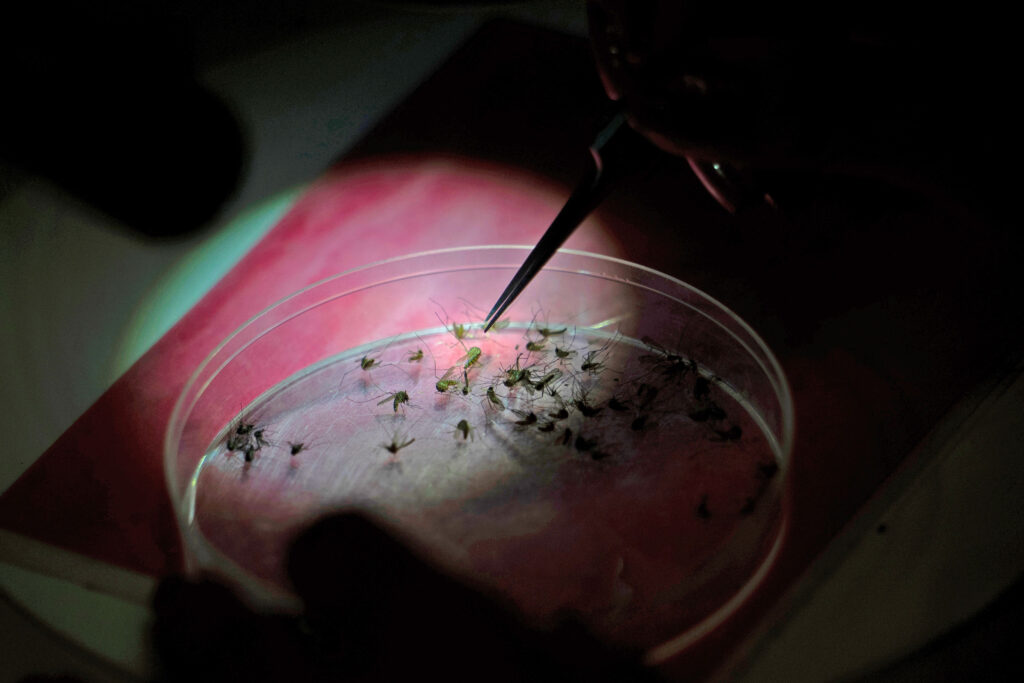
While the results for attracting the target species were mixed, the unexpected capture of so many new species opened up some exciting possibilities.
“We’ve never seen some of these insects before,” Benavides said. “What if we caught something that hasn’t been previously identified. That would be amazing to find out.”
“While Jovana’s method was developed to attract disease vector mosquitoes, it ended up being a unique system that I think other field researchers will employ,” Lent said. “These other species are a growing concern in vector biology, and we don’t know a lot about them. They haven’t been caught or described in a lot of areas, so I think that’s really promising. With a little refinement, this method is promising for what she originally intended and will make a long-term impact on the field.”
Benavides and Lent said unexpected results can be more productive than a flawless experiment that works exactly as predicted.
“It’s always hard to hear the data is messy and not fun to look at,” Benavides said. “When you do something completely new, you have to be willing to take chances and be OK with not having perfect answers. I can think of about three more research projects to do from this one project, and I’m hoping to work with Dr. Lent in the future to continue this research.”
“What Jovana took on is probably one of the hardest things to do,” Lent said. “She tried to develop new methods that are robust and can work in a field setting, which is highly unpredictable. Failure is always an option. But what’s fantastic about failure is when it leads to brand-new questions that you would never have seen or asked before. Some of the things she found were not what we intended, but it’s opening up a large number of avenues of new study and research. That’s what science is.”