


Dr. Christi Erba explores space and time from right here at Fresno State. Erba, an assistant professor of physics and new director of the Downing Planetarium, is part of an international team of scientists researching the composition of distant stars to better understand the history of the universe.
TEMPOS, the Treasury of Extremely Metal Poor O Stars, is an ongoing survey of 29 stars in nearby galaxies using data from NASA’s Hubble Space Telescope and the Keck Observatory in Hawaii. (O-type stars are massive stars that are very bright and can be detected at large distances.) Erba, who began working at Fresno State at the start of the fall 2026 semester, has been working on TEMPOS since her postdoctoral appointment at the Space Telescope Science Institute in Baltimore.
The goal of the TEMPOS project is to learn more about stars in the early universe and resolve discrepancies between observed data and current models of the evolution of the universe, Erba said. Project researchers analyze ultraviolet and visible light from distant stars to determine the stars’ luminosity, temperature and chemical composition.
Since light takes tens of thousands of years to travel from even the closest galaxies outside our Milky Way, observing distant stars is a way of looking at the past. The more distant the star, the further back in time one can see. Observations of the most distant galaxies are peeks into the very early history of the universe.
“When the James Webb Space Telescope got launched, it peered back further in time than ever before,” Erba said. “And what they saw were chemical signatures that they didn’t expect to see, that didn’t fit the model we had for what the universe should look like. What could be causing that? We’re actively trying to figure that out.”
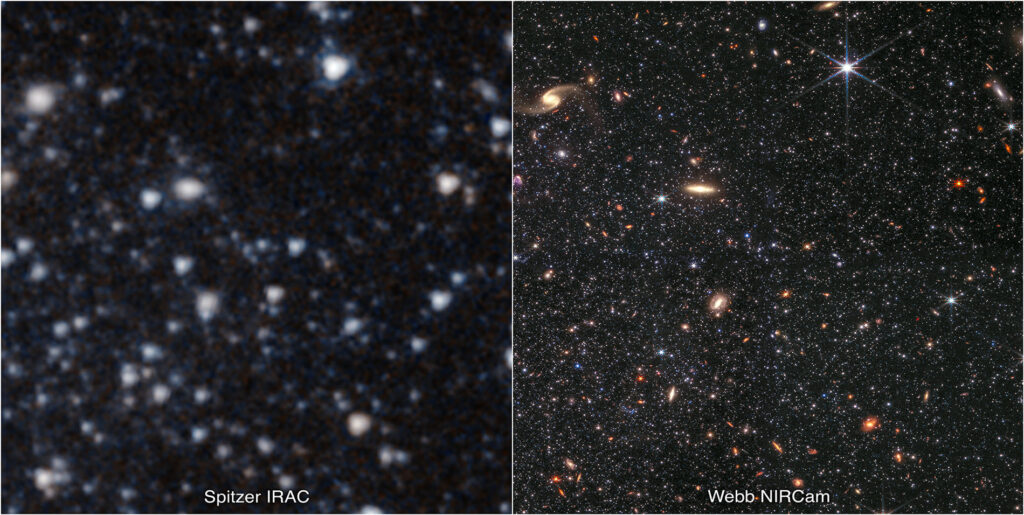
Erba said learning more about stellar evolution could profoundly change our understanding of the early universe.
“With the results coming in from the most recent of NASA’s Great Observatories, we’re learning that massive stars may have been really important to the early development of the universe, perhaps more important than we initially envisioned,” Erba said.
These stars influenced the history of the early universe in two ways. First, massive stars play a role in forging most of the elements in nature that aren’t hydrogen or helium. Elements like carbon, silicon and oxygen — which scientists believe are key elements for biological life — are formed in the core of a massive star and released into the universe at the ends of the stars’ lives, when they explode in supernovas.
Second, every star generates a stellar wind that creates a unique environment around the star, and massive stars project their winds very far into space. The stellar wind of a medium-size star like our sun is driven by pressure — in a massive star, the wind is powered by light itself.
“If I put on my Ant-Man suit and shrank myself all the way down to the size of an atom, I would actually feel the effect of the light of the star pushing on me,” Erba said. “The intense amount of energy driven away from the stellar surface carries away mass. That shapes the circumstellar medium, all the stuff that’s around the star in its immediate neighborhood.”
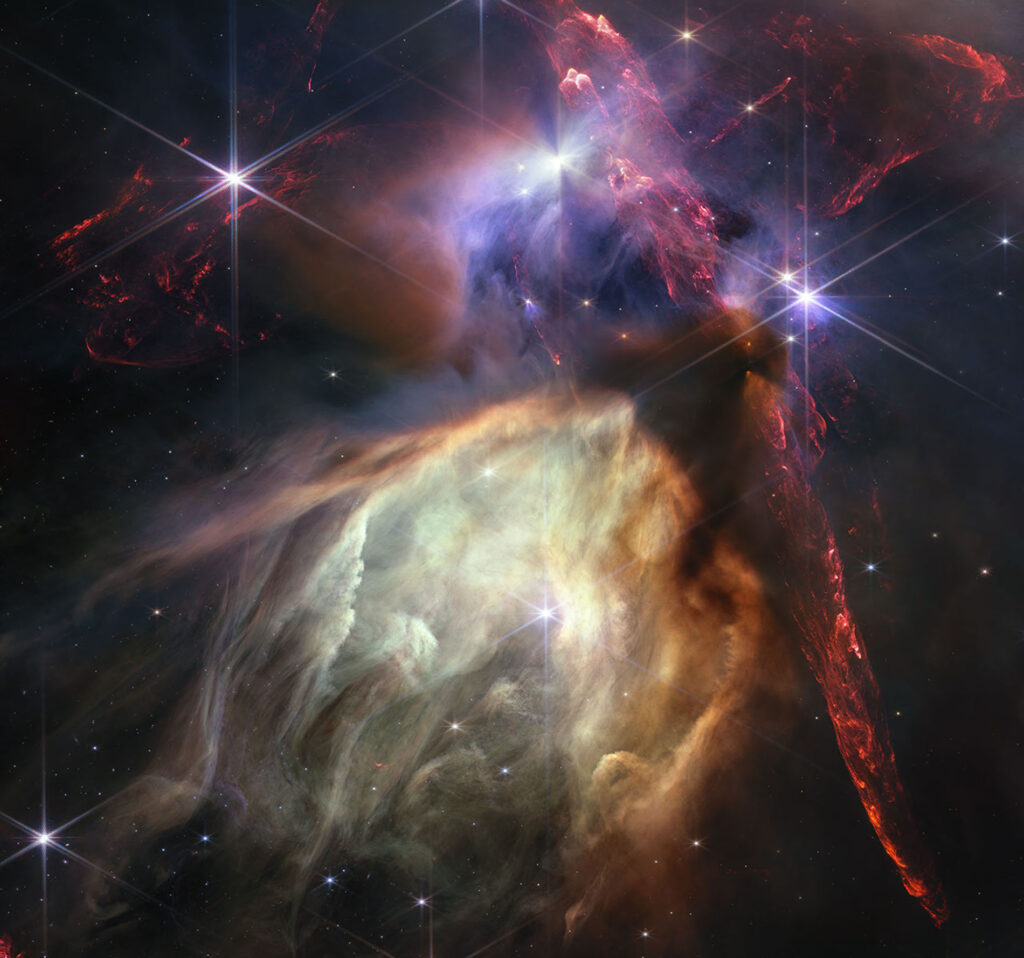
Understanding the earliest stars will help scientists better understand conditions in the early universe. But light from the earliest stars comes from so far away that current technology can’t examine individual stars. The TEMPOS project gets around this challenge by studying stars in closer galaxies that are similar to stars in the early history of the universe.
“We can’t study individual stars at that period of time,” Erba said. “Our optics just aren’t good enough, so we have to study the stars that are close to us. What TEMPOS is doing is observing six different galaxies that are relatively close to the Milky Way, and we’re looking at the massive star population in each of these galaxies, trying to understand how these stars compare to massive stars in our galaxy.”
The low level of metal elements in these stars makes them the best possible observable analogs to stars in the early universe, Erba said.
“In the early universe, conditions were expected to be extremely metal poor,” Erba said. “Metals like carbon and nitrogen are forged in the hearts of massive stars. If a massive star hasn’t had time to live and die and disseminate its elements yet, you can’t have metals. The metallicity content of the six TEMPOS galaxies is lower than that of the Milky Way. It is predicted that the winds of massive stars change when the metallicity content drops.”
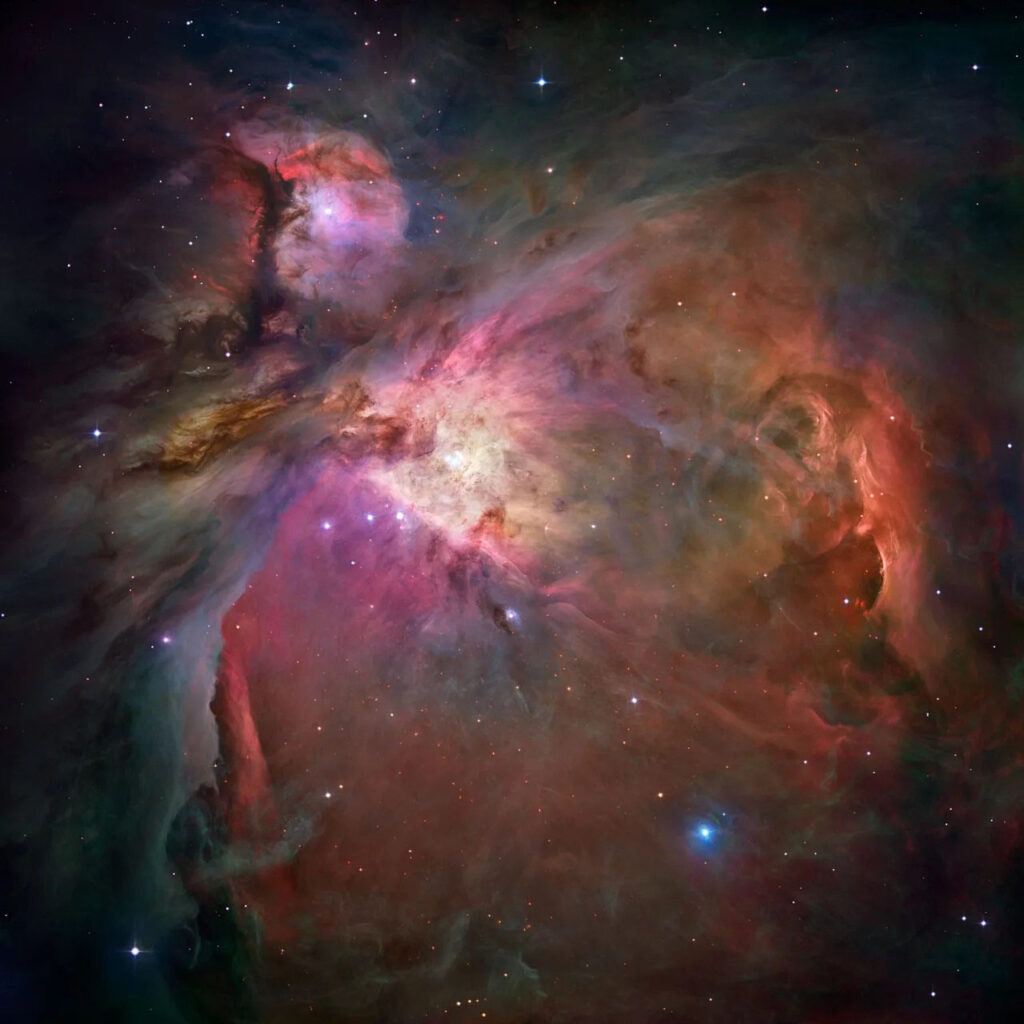
The TEMPOS team has completed an initial visible light survey of 12 stars in the Wolf-Lundmark-Melotte galaxy, located about 3 million light-years away from Earth.
The TEMPOS team recently published a series of papers describing the TEMPOS program and its initial results as well as initial visible light surveys of 17 massive stars in the NGC 3109 galaxy and 12 stars in Wolf-Lundmark-Melotte. The next phase of research will address the four remaining galaxies of the program.
Erba said TEMPOS data has shown a great diversity among massive stars, underscoring that there is still much to learn about stellar evolution.
“Until recently, people thought that massive stars were well understood,” Erba said. “But massive stars are not a monolith. There’s a lot of diversity out there, and that’s a beautiful opportunity for discovery in the future. The exciting thing about this field is that we never stop learning. There are always new puzzles to uncover.”
Erba will continue the next phase of her research at Fresno State, and she feels it is important that astronomy research happens at a university with so many first-generation students.
“Research is for everyone,” Erba said. “These opportunities should be open to everyone, and universities like Fresno State enable the opportunities for anybody. I’m very passionate about working with folks who may have nontraditional backgrounds or paths in the sciences. I want to be part of the next generation of educators who can welcome brilliant, creative people in the field of astronomy.”
The TEMPOS team of researchers also includes principal investigator Grace Telford of the University of Utah; Calum Hawcroft, Julia Roman-Duval and Claus Leitherer of the Space Telescope Science Institute; Kristen McQuinn of the Space Telescope and Science Institute and Rutgers University; Andreas Sander of Christian-Albrechts-Universität zu Kiel and the Astronomisches Rechen-Institut; John Chisholm and Danielle Berg of The University of Texas at Austin and the Cosmic Frontier Center; Varsha Ramachandran of the Astronomisches Rechen-Institut; Yong Zheng of Rensselaer Polytechnic Institute; Abby Mintz of Princeton University; and Evan Kirby of the University of Notre Dame.