
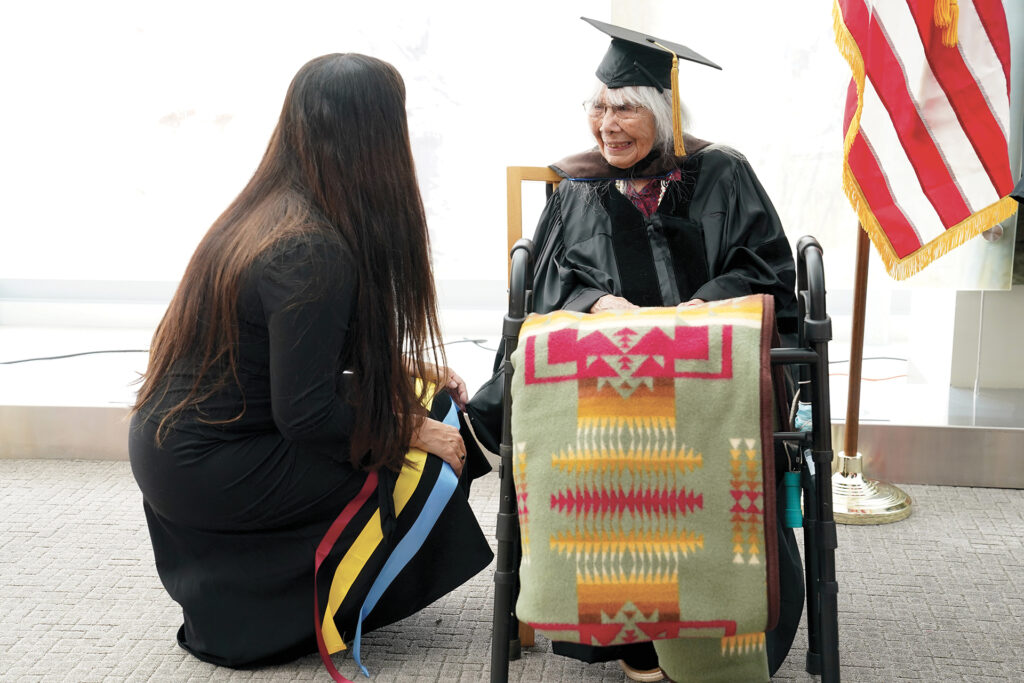
In Yosemite National Park, basket weaver Dr. Julia B. Parker spent most of her life following the traditional techniques of ancestors. Each basket reflects countless hours of careful craftsmanship, high patience and tactical dexterity. In 1983, Queen Elizabeth II visited Yosemite and Parker gave the queen one of her baskets. Today, it is housed at Windsor Castle, while other examples of her work are displayed in museums across the country.
In 2021, Fresno State awarded Parker an honorary Doctor of Fine Arts degree in recognition of her contribution to the Yosemite area and her efforts to preserve the region’s heritage.
“Her story is one President Saúl [Jiménez-Sandoval] loves to share at our Native graduation ceremony,” said Kellie Carrillo, director of Tribal Relations at Fresno State, “because it’s one of the many good connections we have to the people and land.”
Parker’s story reflects the type of relationships the Office of Tribal Relations works to cultivate between Fresno State and tribal nations. Established in 2025, the office’s work includes cultural preservation and consultation, Native student access and success, education and relationship building.
Carrillo herself is a member of the Yokuts Tribe, the Indigenous people whose ancestral homeland includes the area where Fresno State now stands. Before many university events and meetings, attendees hear a land acknowledgment recognizing the Native peoples connected to the region. For Carrillo, those acknowledgments are most meaningful when they are paired with action.
“Our mission is to create and maintain relationships with tribal nations so Fresno State’s priorities and tribal priorities align, while ensuring tribes have a voice in the decisions that matter to them,” Carrillo said.
In addition, the office helps guide the university’s responsibilities related to Native American cultural resources and repatriation. Sara Lively, the repatriation coordinator, first became interested in this work more than a decade ago as a Fresno State anthropology student.
“This is a shared space,” said Lively, reflecting on the land she lives and works on. “I’m a guest here, and I want to learn more about the people.”
Lively helps ensure Fresno State complies with the Native American Graves Protection and Repatriation Act (NAGPRA). The university houses a collection of more than 38,000 cultural objects – including baskets, beads, pottery and other items – many of which were acquired through archaeological research and teaching conducted decades ago.
“We, as a university and as an academic discipline, must be accountable moving forward,” said Dr. Dvera Saxton, a professor in the Department of Anthropology and a member of the campus California NAGPRA Committee. “That has to happen through repatriation as well as evolving our teaching and research practices to respect tribal sovereignty and protocols.”
Anthropology and American Indian Studies faculty recently launched a CalNAGPRA and Repatriation certificate students can complete alongside their major. Anthropology faculty also redesigned archaeology courses to center tribal protocols, perspectives and partnerships.
“Repatriation is also about nurturing our relationships with tribes and listening to how else we can best serve them as a public university,” Saxton said.
Carrillo, Lively and their student assistants work collaboratively with tribal nations to facilitate the return of ancestors and cultural belongings. On a day-to-day basis, this includes storing, organizing and documenting the status of artifacts, as well as outreach and meetings with tribal members.
“Our first measure of success is going to be when all the ancestors and their belongings are returned from Fresno State to their homes,” Carrillo said. “Beyond that, success means creating opportunities for Native communities on campus through community events, expanded student resources, increased Native student enrollment and coursework that reflects Native perspectives.”
Like a basket being woven, the work is meticulous and rewarding. Lively recalls an early meeting with tribal leaders, wherein a Yokuts elder shared something that has stayed with her.
“Fresno State wants us here,” the elder said. “They want us here, and we belong here.”
The comment still brings tears to the eyes of both Lively and Carrillo.
“There are a thousand reasons why you wouldn’t feel belonging in higher education,” Lively said. “To hear that was a big win and a big motivator. It reinforced that this work is about more than compliance; it’s about relationships, respect and making sure tribal nations know they have a place here.”
Written by Esra Hashem (‘13, ‘16, ‘21)