
To celebrate the start of its 50th year, the Fresno State Armenian Studies Program presents “Ara Oshagan: Armenian Diasporic Trajectories: Los Angeles, Beirut, Artsakh and Fresno,” a photographic exhibition tracing diasporic displacement, continuity and futurity across four interconnected Armenian cities and spaces.
Los Angeles, Beirut and Fresno are sites of Armenian diasporic life and presence, while Artsakh represents an ancestral homeland that was emptied of its Armenian population and became diasporic following the Azerbaijani military offensive in 2023. Oshagan’s work explores these spaces, communities and stories as they persist across generations and form a fractured trajectory connecting diaspora, belonging, memory and hereafter.
A reception will be held from 4 to 6 p.m. Sunday, Sept. 13, at the Fresno State Library in the Leon S. Peters Ellipse Gallery on the second floor. The exhibit will be on display from Sept. 1 to 30. Gallery hours are 10 a.m. to 7:30 p.m. Monday through Thursday, 10 a.m. to 4:30 p.m. Friday and Saturday and noon to 7:30 p.m. Sunday. Admission is free, and the gallery is open to the public.
The exhibition will include work from a recently launched collaboration between Oshagan and the Armenian Studies Program that examines the Armenian community’s deep roots in the San Joaquin Valley.
“What he is doing is beginning to document the oldest Armenian families in Fresno and taking photos of some of those family members,” said Barlow Der Mugrdechian, professor and coordinator of the Armenian Studies Program at Fresno State. “It’s something that’s unique, something we haven’t seen before in Fresno.”
Oshagan is a multi-disciplinary artist, curator and cultural worker whose practice explores collective and personal histories of dispossession, legacies of violence, identity and (un)imagined speculative futures. He has published four books of photography and has presented his work at the Annenberg Space for Photography, International Center of Photography in New York and TedX Yerevan. Oshagan is an artist-in-residence at 18th Street Arts Center in Santa Monica, a curator at ReflectSpace Gallery in Glendale and is the exhibition director for the Armenian American Museum project in Glendale.
The exhibition is sponsored by the Armenian Studies Program, the Leon S. Peters Foundation, the Thomas A. Kooyumjian Family Foundation, the Ralph Shabazian Armenian Memorial Fund and the Florence Elaine Hamparson Memorial Fund.
The exhibition is the first in a series of events in 2026-27 marking the 50th anniversary of the Armenian Studies Program, including:
- 7 p.m. Sept. 25: “Phrasing the Arts” book talk with Dr. Abraham Terian in Industrial Technology (Room 101).
- Oct. 23 to 24: “Resilience and Reconstruction: The Armistice Period in the Ottoman Empire (1918-1923),” an international conference in the University Business Center.
- 7:30 p.m. Oct. 30: “Ancestral Songs, Prayers and Lullabies: An Evening of Music, Memory and Live Art” with internationally recognized operatic soprano Isabel Bayrakdarian, in conjunction with the Philip Lorenz Keyboard Concert Series at St. Paul Armenian Church.
More events are planned and can be found on the Fresno State calendar as they are added throughout the year.
Celebrating 50 years
The Armenian Studies Program at Fresno State can trace its roots to 1960 when UCLA professor Richard Hovannisian first taught an extension course on campus. In 1967, Dr. Louise Nalbandian started teaching Armenian history courses through the History Department. She began adding Armenian language and culture classes and brought in part-time instructors as she developed a broader program.
After Nalbandian passed away unexpectedly in 1974, the program went on a two-and-a-half-year hiatus until Dr. Dickran Kouymjian was hired in spring 1977 and established the Armenian Studies Program. Under Kouymjian’s leadership, the program integrated its courses into the university’s required general education and gained widespread acclaim. In 1985, Barlow Der Mugrdechian was hired, adding a second faculty position.
After 31 years as the director of the Armenian Studies Program, Kouymjian retired in 2008, and Der Mugrdechian was appointed the coordinator, a position he still holds.
In addition to language, history and culture courses, the program has offered summer study abroad courses in Armenia for nearly 40 years. The trips are typically two or three weeks and allow students to be immersed in the language while the classroom teachings come to life.
“It’s really been…popular, and I think effective in the sense of cementing the knowledge and culture in students,” Der Mugrdechian said.
While in Armenia, Fresno State students have the opportunity to tour the sites mentioned in their textbooks and interact with local students attending Yerevan State University, building international relationships that deepen their cultural connection.
Der Mugrdechian also serves as the adviser for “Hye Sharzhoom,” a student-run newspaper. It was established in April 1979 to commemorate the anniversary of the Armenian Genocide. Initially designed as an insert in The Collegian, the quarterly insert has grown to an international readership of over 6,000 people and is the oldest regularly published Armenian student newspaper in the world.
“[Hye Sharzhoom] provides an outlet for students who are creative and want to write and cover events, Armenian events or Armenian-related events, on campus or in the community, or provide a voice for students,” Der Mugrdechian said. “Through our communications through Hye Sharzhoom, people who are outside of the community, who also have just learned about the program, see the value in the program and want to support students through the scholarship.”
The newspaper is one of many ways the Armenian Studies Program connects with the community. Even after graduating, alumni remain engaged.
“Just about everyone in the [local Armenian] community has had a son or daughter or nephew or grandchild or some relative that has taken courses at Fresno State,” Der Mugrdechian said.
The program keeps those ties long after people graduate through its lecture series, film screenings, art exhibitions and other events that are free and open to the public.
“I think that has really tied us into the community and made it really important because we get the support both from people participating in programming and also financial support, which helps to keep us growing and successful,” Der Mugrdechian said.
Those philanthropic partnerships, in turn, help the next generation. With 47 named scholarships, the education of dozens of students is supported through the community’s generosity every year.
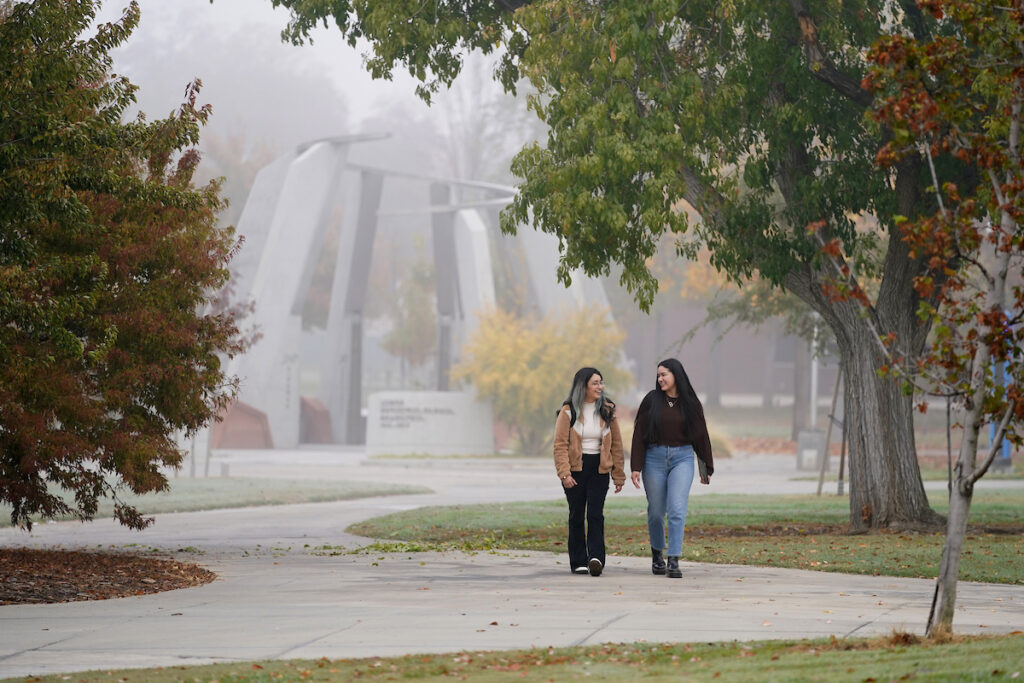
In 2015, to mark the 100th anniversary of the Armenian Genocide, a monument was constructed in a central location along the Maple Mall on Fresno State’s campus. The project was entirely community-funded and permanently links the campus to the local and international Armenian community.
“I always felt that to have an Armenian Genocide Monument on campus would be very important because there would be so many people that would see it. Everybody just walks by there every day,” Der Mugrdechian said. “It’s something that also enhances our program to know that, at our campus, we also have an Armenian Genocide Monument, which no other campus in the United States has.”
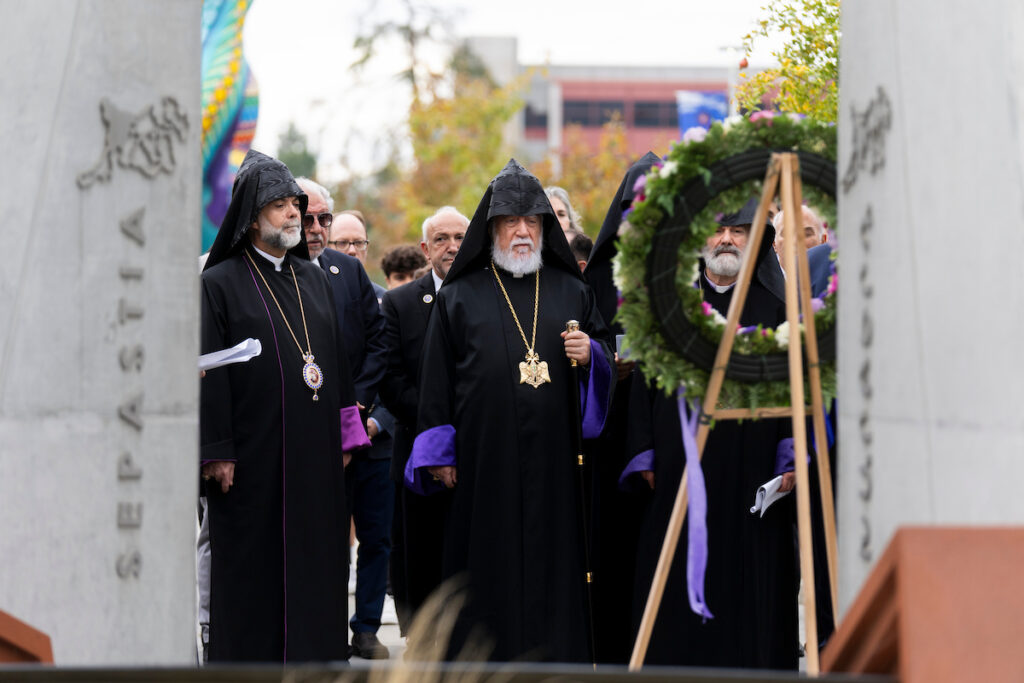
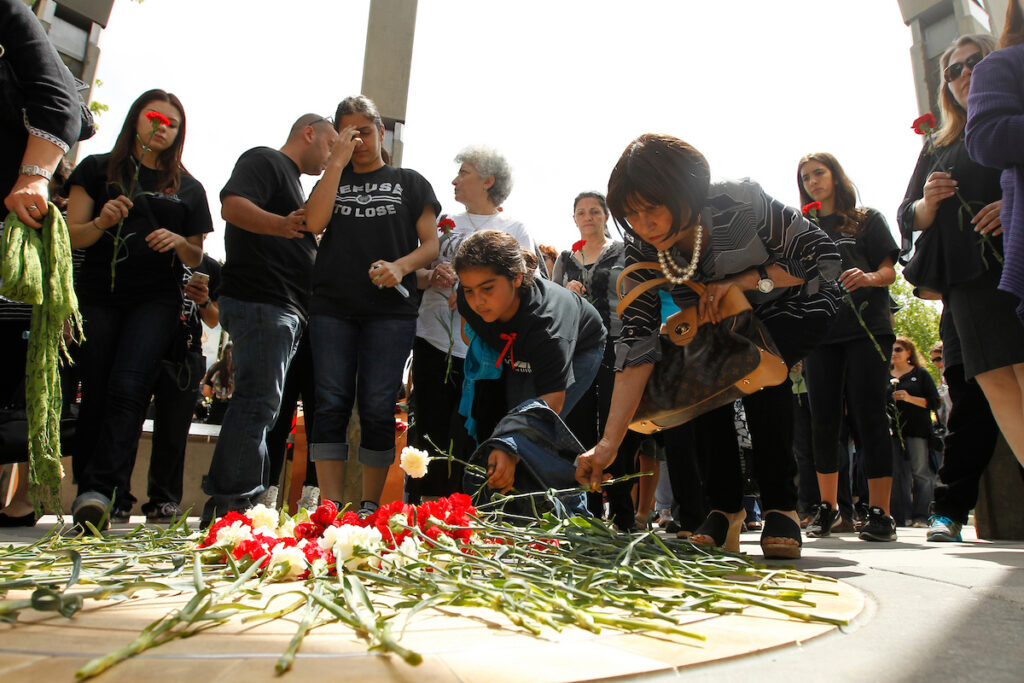
On April 24 every year, the genocide is remembered with a student ceremony during the day and a large community commemoration in the evening that brings hundreds to the campus. It’s not unusual to see people from Armenia attending the annual event. The monument and the commemoration, Der Mugrdechian said, are a testament to the impact the Armenian Studies Program has had on the community, and the Armenian community has had on Fresno State.
Like the diasporic trajectories Oshagan’s photographs trace, the students and alumni who carry the program forward embody 50 years of connecting memory to the present, and the present to what comes next.
Top photo: Ara Oshagan, Family Gathering, N. Hollywood, 2002, from Traces of Identity series, 2000-2010