

As Fresno State nears the 10th anniversary of the passing of alumna Mireyda Barraza Martinez, the university’s English Department marks a bittersweet milestone – the first two recipients of the memorial scholarships in the poet’s name will earn their Master of Fine Arts degrees in creative writing in May.
Through the efforts of dozens of community members — including a core group of Barraza Martinez’s family and the faculty, staff and alumni who have made small monthly and annual gifts over the years — the College of Arts and Humanities endowed the scholarship fund in June 2023.
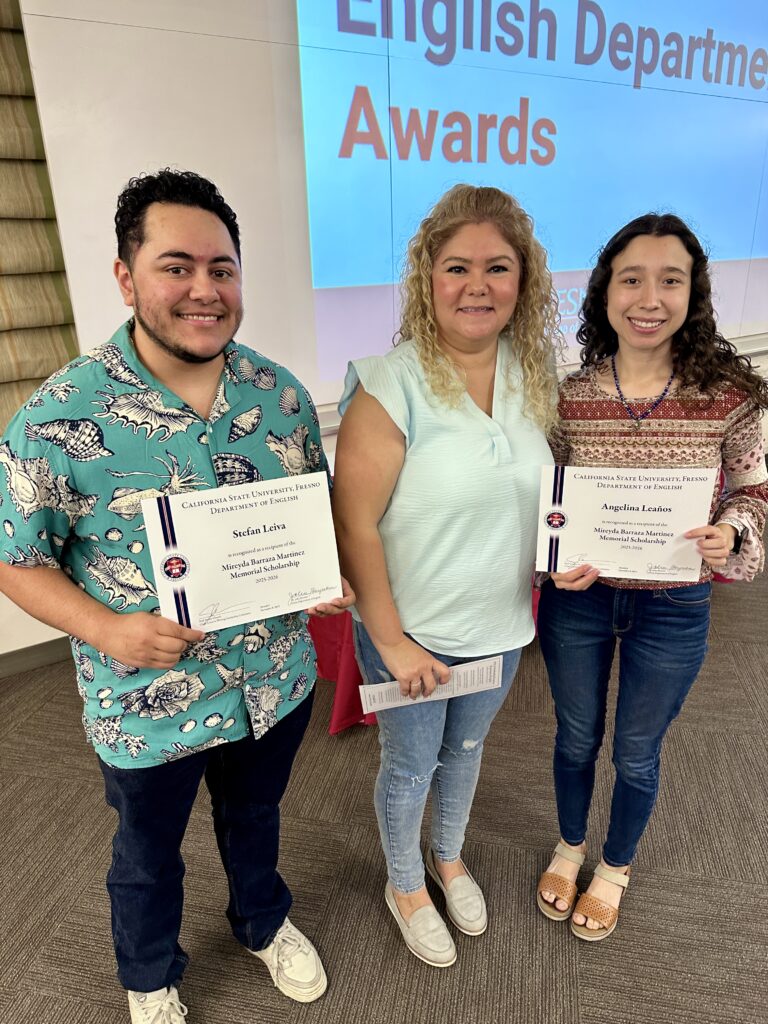
For the academic year 2025-26, the first Mireyda Barraza Martinez Memorial Scholarship awards were presented to creative writing graduate students Stefan Leiva and Angelina Leaños.
Adam D. Goldberg, director of development for the College of Arts and Humanities, said the scholarship endowment came to life over nearly a decade, “transforming shared loss into something enduring, carried forward by a community that refused to let Mia’s name fade.
“Our legacy as humans is rarely shaped by a single grand gesture,” Goldberg said. “Instead, it’s built gradually, piece by piece, over time. Mia’s life reflected that truth through her writing, her friendships and her devotion to her community. Her scholarship was built in that same spirit.”
A daughter of farmworkers who grew up in east Porterville, Barraza Martinez earned her bachelor’s degree in English literature from Fresno State in 2014. She served as a graduate artist in the campus library’s Laureate Lab, studying with Juan Felipe Herrera, U.S. poet laureate emeritus. She was an organizer with the Chicanx Writers and Artists Association, and she was politically active in local communities, particularly for the rights of undocumented students.
Barraza Martinez died at age 29 in an auto accident in November 2016, one semester away from earning her Master of Fine Arts degree. The university posthumously awarded her MFA in May 2017.
Meet the first recipients of the Barraza Martinez scholarship, which will now continue to be awarded annually, in perpetuity.
‘I’ve always tried to be in a stance of hope’
A third-year fiction candidate, Stefan Leiva works on campus as a graduate teaching associate for the English Department, where he teaches first-year writing courses and a creative writing course in fiction. He also works for the College of Arts and Humanities as a tutor in the Writing Center.
As a recipient of the inaugural Mireyda Barraza Martinez Memorial Scholarship in his third and final year as a graduate student, he said it felt like “such an honor, a clarifying moment.” Previously, he received the Andrés Montoya Memorial Scholarship in his second and third years; the Philip Levine Scholarship in his second year; and the Edward and Alberta Brown Scholarship in his first year.
“Getting recognized with one of the first Mia scholarships really made me grateful for my time here,” he said. “It put things in perspective, recognizing my own accomplishments of the past three years, which I don’t really recognize often enough.”
Leiva earned his bachelor’s degree in art from Fresno State, with an emphasis in animation. He remembers early on in life wanting to become an artist.
When he was a kid, he said, his teachers and friends first responded positively to a drawing of Elvis Presley he made for a class assignment, encouraging his early interests. Later, in the fourth grade, he received an assignment to write from the perspective of an object, so he wrote, illustrated and assembled a zine from the viewpoint of a toothbrush, earning rave reviews when his teacher read his work to the entire class.
He also remembers, in adolescence, watching the 2012 animated film “Rise of the Guardians,” a fantastical adventure movie where Santa Claus, the Tooth Fairy, the Easter Bunny and others try to stop a bogeyman named Pitch Black from plunging Earth into eternal darkness. Seeing the film and its elaborate look and story cemented his initial wish to study animation.
But despite these early moments, the further he progressed through his undergrad program, the more Leiva realized that animation wasn’t likely the career path meant for him.
“I was getting a lot of stress and anxiety about not being good enough,” he said, “not living in the right place for opportunities, not knowing if I’d be able to pursue the art I want to make, and it kind of ended up ruining my relationship with art for a while.”
Leiva also minored in creative writing as an undergrad, and he remembers thinking, in his senior year, “hey, these creative writing classes never gave me stress the way my art classes did.” So, he excitedly applied to the Master of Fine Arts program while earning his bachelor’s in art — but, he was disappointed to be denied admission on the first try.
“That was also the year that I realized I was transgender,” Leiva said, “and it was through writing the short story for my first MFA application that I really realized it. So, that year kind of ended up with me trying to deal with this new part of my identity, and trying to get into a position where I could really progress with it.”
Leiva moved out of his family’s house. He tried freelance writing for dating apps and gaming websites. And he took a retail job for two years, where he “learned to get over my fear of talking to people,” he said, and started growing into a new version of himself.
Three years after finishing his bachelor’s, Leiva re-applied to the MFA program and got in.
Leiva said his second writing sample was much more developed, and that the short story’s characters spun off and evolved into what became his thesis manuscript, “Lucifer’s Exception,” which associate professor Venita Blackburn described at his MFA showcase performance as “a trans, coming-of-age, young-adult novel, written with grace, authority, insight and awareness of the torturous magic that is loving your enemy.”
Leiva said he has now realized that he can’t separate his writing from his art.
“Looking back, a lot of the art that I was making always had a story behind it,” he said. “I wasn’t really the kind of artist to draw still lifes or objects, or even just to doodle. The things I was doodling, these were characters with names and stories and relationships. Very rarely did I draw anything that wasn’t tied to a narrative somehow. Writing was always there, but I couldn’t see it behind the art.”
Leiva said he wants to write young-adult fiction that’s “not all just tragedy and trauma,” where people from marginalized groups “can have happy endings, especially now in a world that feels hostile to all of us.” So far, his short stories have been published twice in the San Joaquin Review.
“Villainizing queer people in stories is clearly meant to be distracting from the real issues and villains,” he said. “But, at least for me, I’ve always tried to be in a stance of hope.”
Teaching undergraduate students about the craft and intention of writing and reading, both in freshman composition classes and the general-ed fiction workshop, has taught Leiva more than he expected, about arriving in a different place than you were at the start.
“You make intentional decisions when writing, and that’s something I really communicate to my students,” he said. “I try to communicate to them that everything that you’re putting into the writing is intention, it has to work toward something, and the benefits you can get from that is substantial.”
After graduation, Leiva hopes to gain more experience teaching English at the community college level, and to find a publisher for his debut novel. His ultimate goal is to land a university teaching job in the Bay Area, where he can relocate with his girlfriend and write more novels.
Leiva’s newfound confidence within Fresno’s writing community, he said, led to one of his MFA peers recently calling him a “social butterfly,” a description he’d never pictured for himself.
“I’m hoping what I’ve learned here, how to reach out and make friends and make connections, does stay with me,” he said. “So, no matter where I go, I’ll be able to recreate community for myself.”
‘I wanted to keep pursuing creative writing, my passion’
A third-year poetry candidate with an emphasis in publishing and editing, Angelina Leaños works on campus as an editorial assistant for the Creative Writing Program, and as a student assistant in the Cross Cultural and Gender Center. She also serves as managing editor and poetry editor for The Normal School magazine, as well as president of the Chicanx Writers and Artists Association.
She said it was an “absolute honor” to be a recipient of the inaugural Mireyda Barraza Martinez Memorial Scholarship in her third and final year as a graduate student. In her first year, she received the Edward and Alberta Brown Scholarship.
“I learned about Mia’s bright spirit and inspiring poetry during my first year in the MFA program,” she said, “and I hope that she would be equally inspired by the positive impact she left.”
Leaños experienced success early in her creative writing life. She served as Ventura County Youth Poet Laureate in 2020 and 2021, while earning her bachelor’s degree in English literature at Cal Lutheran University in Thousand Oaks. She knew she wanted to apply to graduate school, and initially her parents encouraged her to take the path toward a doctorate. But “it didn’t feel right,” she said, when researching doctoral programs.
“I wanted to keep pursuing creative writing, my passion, rather than getting a doctorate,” Leaños said. “Thankfully, my parents eased their expectation.”
Leaños learned from her research that Fresno State had a strong Master of Fine Arts program. And, it didn’t hurt that her dad and other members of her extended family were Fresno State alumni. Soon, she was Bulldog bound.
Earlier, while starting out writing fictional short stories in fourth grade, Leaños decided she wanted to be a published author. At first, she was inspired by the stories of her dad, whose first dream was to become a writer before he changed his career path to social work.
After participating in a Poetry Out Loud competition at Channel Islands High School, she fell in love with poetry. From there, Leaños met other poets and writers in her community with diverse identities, and “writing became a tool for me to explore my own.”
“My grandparents immigrated here from Mexico, and even though I’m only two generations away from those roots, I had a lot of imposter syndrome growing up,” Leaños said. “As a child, I’d respond to my grandparents in English and quickly excelled in the language, leaving Spanish in the dust. For years, this disconnect and my desire to reclaim the language — and, in doing so, find belonging — was a huge subject in my poetry, and it still is.”
In recent years, Leaños has become more proficient in Spanish by practicing it both in conversation and in her poetry. Her perspective has shapeshifted: from a lack of belonging to more of a sense of pride in her heritage and family history.
Leaños also writes about her experiences as a bisexual Latina. She said growing up in a Mexican American culture that can be very traditional, she didn’t acknowledge or start to accept her full self until late in her undergraduate years — thanks, in part, to an accepting family who made her feel safe, and also thanks to poetry.
“While I don’t see myself as a spokesperson for all queer Latines, I do wonder how many of my ancestors had to conceal their identities to fit cultural norms,” she said. “I feel I owe it to myself as well as my roots to be authentic in all aspects of my writing.”
Leaños is completing her thesis manuscript, the poetry collection “Bloodtree Blooming,” which associate professor Mai Der Vang described at her MFA showcase performance as “a contrapuntal assemblage of concrete and visual structures, photographic deconstructions, poems set as instructions, stage directions, incantations and direct addresses to her grandfather.”
Dozens of the individual poems in her manuscript have already been published in literary journals, including Urban Word, Arkana, Poetry Daily, Reed Magazine and Wild Blue.
“It’s amazing to reflect on my years in the program and see how far my writing has come,” Leaños said. “I’ve learned to push the boundaries of both form and language in ways I wouldn’t have thought of on my own. I’m also learning how to honor other people’s voices while incorporating them in my writing, such as my abuelo’s voice, which is crucial to my thesis.”
After graduation, Leaños will travel to Dallas as the inaugural recipient of the Four Palaces Publishing literary residency. The weeklong residency offers queer writers of color “time, care and space” to deepen their writing practice. While there, she will lead a generative writing workshop at the Apprentice Creative Space, inside the Oak Cliff Assembly arts and business hub.
Leaños plans to then return to Ventura County to reconnect with family and her original writing community, while starting the search for a full-time editorial job in the publishing industry or in arts communications.