
What is the Valley?
At the northern edge of the Fresno State campus, the view extends across the rich agricultural soil of the 1,000-acre university farm and out toward the snow-dusted peaks of the Sierra Nevada mountains. To the left, a cluster of buildings is framed by the Bulldog water tower; to the right, a diverse mix of students move about. In the warm heat of summer, the scene appears sharp and bright, while in the colder months, it may be obscured by a dense tule fog.
This is the Central Valley — one of the most fertile, complex and misunderstood regions in the country — and Fresno State sits squarely at its heart.
‘Where the palm meets the pine’
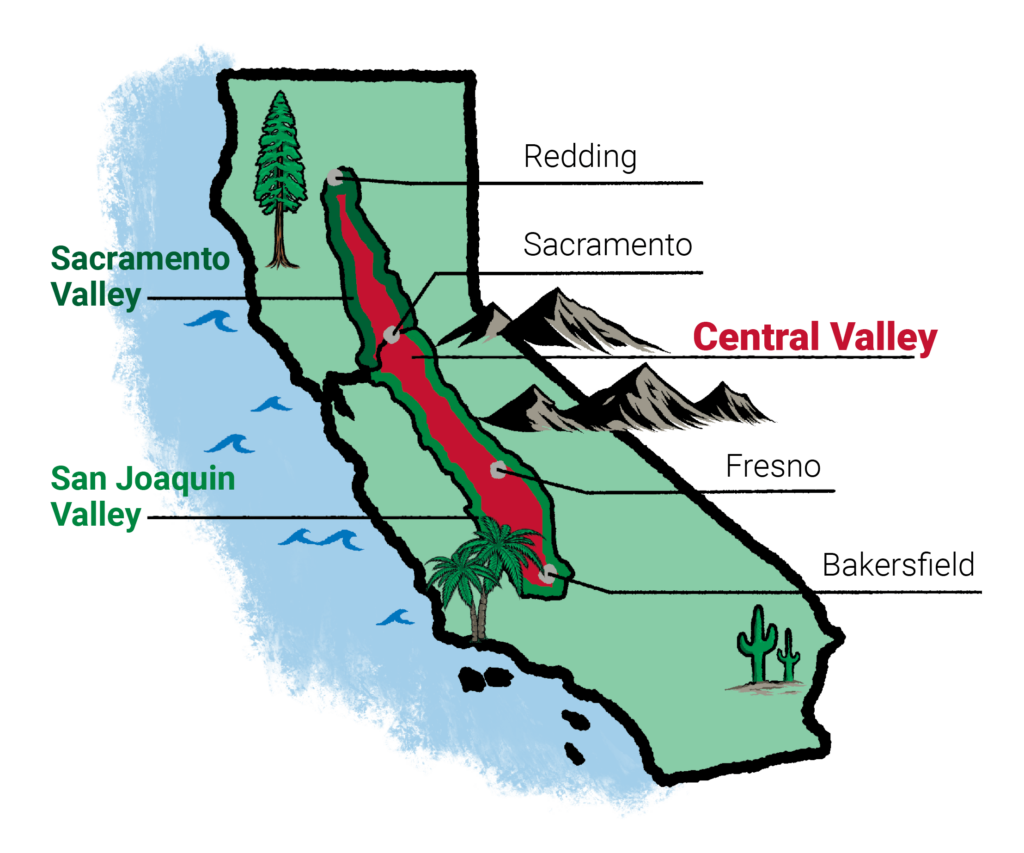
Geographically, the Central Valley stretches 450 miles from Redding to Bakersfield, hemmed in by the Coast Ranges to the west and the Sierra Nevada to the east. It is divided into two large parts — the northern one-third is known as the Sacramento Valley and the southern two-thirds is known as the San Joaquin Valley. Within the San Joaquin Valley, Fresno is the largest city, a crossroads where northern and southern California influences mingle.
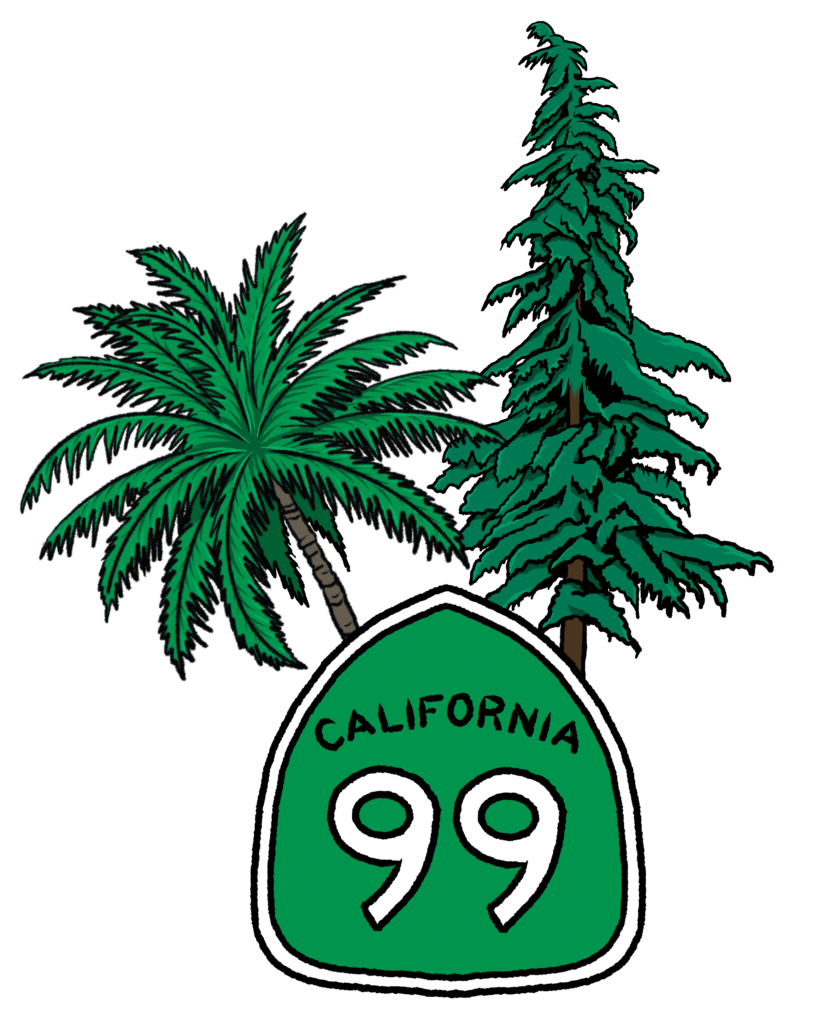
Dr. Scott Peterson is an assistant professor in geomatics engineering at Fresno State. He said the geographic center of California is often considered to be located in North Fork, east of Highway 99 in Madera County. This stands in contrast to the popular belief that the midpoint lies “where the palm meets the pine” — two trees planted in the median of Highway 99 near Avenue 11 in Madera.
The palm, symbolizing Southern California, and the pine, symbolizing Northern California, have long been seen as markers of the state’s north-south transition. Yet, their exact origin remains uncertain, with no definitive historical record of when or why they were planted — though they are thought to be at least a century old.
“I give extra credit to students in my classes to go visit where the palm meets the pine, or North Fork — for them to see the center of California,” Peterson said. “Even if it may be mathematically not perfect, who cares? It’s a pretty cool thing we have right there. And to be honest with you, when you look at a map yourself and try to find the center of California, it’s pretty close.”
Public concern arose when residents believed the trees might be removed to accommodate freeway expansion. But the California Department of Transportation (Caltrans) reassured the community: the landmark palms and pines will not be lost. Instead, they will be relocated nearby, with 15 new palms and 15 new pines planted to honor the site next year.
Peterson, a Valley transplant who has been in Fresno for 11 years, is glad the symbolic mark is being preserved.
“I’d describe the Valley’s land as precious — so valuable. People have farmed it, provided for their families, provided for other people’s families. It becomes such an integral part of life that you protect it, almost like a member of your family,” he said. “When I drive on the 99, and I pass the palm and the pine, and I see rows of crops, I see beauty.”
Fuel for the world
The Valley is known as the agricultural capital of the world. Almond orchards bloom in early spring, sweet corn peaks in freshness by June, and grapes hang heavy in late summer and fall.
“The scale of the production is remarkable,” said Dr. Sharon Benes, an agriculture professor in the Department of Plant Science at Fresno State. “Our mild, mediterranean climate provides a very long growing season with almost continuous sunshine from the late spring to early fall. And ironically, the lack of rainfall in the summer makes it easy for farmers to control soil moisture through irrigation, which they can manage according to the most suitable times for the crop.”


Though it represents less than 1% of the nation’s farmland, the Central Valley produces more than a quarter of the country’s food supply. Nearly 40% of America’s fruits and nuts are grown here, along with over 250 crops each year — making the Valley the most vital and productive agricultural region in the world. It’s no wonder Fresno State Athletics proudly features the Green V, honoring the Valley’s rich agricultural heritage and the hardworking communities that help feed the nation.
“When I think of agriculture’s effect on the culture, I think of the resilience of the people,” she said. “Not everyone here is involved in agriculture, but there is a sense of land stewardship, of people wanting to do a good job, of resilience.”
Pride rooted in its people
Dr. Matthew Jendian, professor of sociology at Fresno State, agreed.
“There is a sense of resilience, hard work and grit in the Valley, because of the economic challenges people have faced, and how they have overcome,” he said.
Known as one of the most diverse places in the country, immigration patterns show a long history of movement into the region — from Indigenous communities whose roots stretch back thousands of years, to Dust Bowl migrants in the 1930s, to farmworkers and families from Mexico and later refugees from Southeast Asia. Armenian and Greek survivors of genocide, Sikh and Punjabi immigrants from India, and more recent arrivals from the Middle East have also made the Valley home, each bringing their cultures, traditions and faiths.
Over 100 languages are spoken within Fresno schools, a testament to the linguistic diversity within the region.
“Where else can you go in the world and hear a hundred different languages, or taste food from every corner of the globe?” Jendian asked. “In Fresno and the Valley, diversity touches all the senses — we can see it, hear it, smell it, taste it and even join in. That richness is something we need to celebrate.”
Jendian emphasized the Valley is not a “melting pot,” where differences are erased, but a place of pluralism where communities adapt to American life while also retaining their languages, religions and traditions.
“We don’t have to give up who we are to become American,” he said. “We can add to our cultural capital while embracing our American identity.”
While the Valley is not without its challenges — poverty, inequality and questions of regional self-esteem — Jendian said it is also a region defined by love, wisdom and perseverance that cannot be measured by money alone.
From the palm and the pine to the fields and classrooms, the Valley is defined by both its land and its people; it is a place where heritage and hope grow side by side.
“When I think of Pride of the Valley, I think of our people,” he said. “Their grit, their strength, their love — that is what makes me proud.”
And that’s what Fresno State represents.
Written by Esra Hashem (‘13, ‘16, ‘21); Illustrations by Todd Graves (‘03); Photos by Cary Edmondson (‘03)