

A professor whose teaching centers student knowledge and whose research uplifts indigenous voices. An attorney specializing in education law who takes cases that improve the classroom environment. An educator who trains other teachers how to write alongside their students.
Fresno State’s Master of Arts program in English this year marks its 75th anniversary, and its diverse and accomplished alumni continue to make a broad impact on the communities they live in and serve.
In the past three-quarters of a century, dozens of the program’s graduates have gone on to earn doctorates at leading colleges and universities throughout the nation, while hundreds more have built careers as secondary school teachers, community college instructors and program administrators in the Central Valley and beyond, said John Beynon, chair of the English Department.
Many who earn their master’s in English also have built careers in fields outside of education, Beynon said, including law, library science, business, politics, communications and publishing.
“That our M.A. graduates have found success in such a wide array of professions speaks to the ways the program prepares students to thrive and serve society in many meaningful ways,” Beynon said. “I am always thrilled when I learn how our master’s alumni are using their degrees to build a purposeful life for themselves and to give back to the communities they live in.”
To mark the program’s diamond anniversary as Central California’s home for literary scholars, meet three alumni gems from across recent decades.
Lupe R. Collins — assistant teaching professor
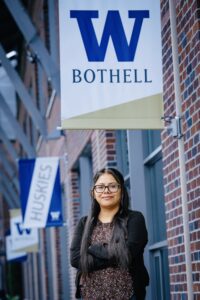
Lupe R. Collins is in her second year as an assistant teaching professor in the School of Interdisciplinary Arts and Sciences at the University of Washington Bothell, north of Seattle.
Collins teaches research writing to mostly freshmen and sophomores. She said her goal is to create a student-centered classroom where students use their life experiences and prior knowledge to contribute to their collective learning.
“The student population at UW Bothell is extremely diverse, and they often remind me of the students I worked with when I taught English 5A and 5B at Fresno State,” Collins said. “I love it.”
In addition to teaching, Collins also serves on her school’s diversity committee, which includes work on the WA Immigrant Solidarity Network, a project that builds power for immigrants and refugees through peaceful, nonviolent action.
Collins earned her bachelor’s degree in English literature from Fresno State in 2015 and her master’s in English (rhetoric and writing studies) in 2017. She was awarded the Graduate Dean’s Medal from the College of Arts and Humanities.
After leaving Fresno, her academic journey continued at the University of Wisconsin-Madison, where she earned a Ph.D. in English, composition and rhetoric in 2024. Just months after finishing her doctorate, Collins landed her dream teaching-track position.
“It is still hard to believe I am here,” she said. “As in, all the years of hard work actually paid off. My mom likes to tell people her daughter is a profesora, and that makes me happy because I know I make her proud.”
Collins’ research interests focus on literacy studies, tracking how transnational literacies and migration impact one another.
Her parents, she said, originate from the Mixtec community of San Miguel Cuevas, or “El Pueblo,” an indigenous tribe from the region of La Mixteca in Juxlahuaca, Oaxaca in southern Mexico.
To this day, the community in El Pueblo is primarily oral and has embraced both traditional and non-traditional literacy practices, as well as non-literate practices, through time and across borders, Collins explained.
“My research uses methods such as oral histories, testimonios and cuentos to understand how oral communities such as El Pueblo make sense of the world around them, and how they navigate living in a literate society as they migrate out of their pueblo,” she said.
Despite growing up in the diverse city of Fresno, Collins said she and her family faced discrimination because they are Indigenous. Non-Indigenous communities of all kinds, including Latine folks, perceived them as inferior, uneducated and illiterate, she said, and for years she held on to this idea.
“As I advanced in my college education, and as I continued to observe my community and their meaning-making, I came to better understand the value they place on non-literate practices such as orality, spirituality and rituals,” she said. “Rather than seeing this as a negative, we understand that part of being human means we consciously make the decision to value different things.”
The goal of her research is to highlight and value Indigenous knowledge, for communities that often feel invisible in the U.S.
“My parents’ stories and the stories of my community need to be written and shared,” Collins said. “It gives us a platform to tell our own stories as they occurred — this is who we are, this is why we are here and this is why our indigeneity matters.”
Collins said she deeply values how Fresno State’s English Department presented and demonstrated the concept of community. As an undergraduate, she was more focused on getting her coursework done and getting good grades, she said. But when she entered the master’s program, she began to see there was much more to it than just the degree.
“From the beginning, I felt included in this community, and the sense of belonging is what drove me to become more invested,” she said. “I carried this with me as I went on to do my Ph.D. and even now in my current position, and I want to replicate this community that took me in at Fresno State.”
David A. Moreno — attorney
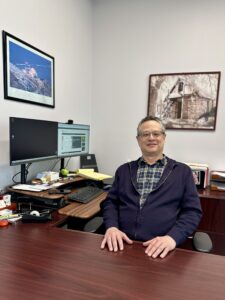
David A. Moreno works in Fresno as an attorney with Fagen Friedman and Fulfrost LLP, also known as F3 Law, a firm that specializes in public education law. F3 Law has eight offices throughout California and in the Midwest.
Moreno spends his time helping clients address labor and employment issues in their school districts. This could include drafting and reviewing legal documents, participating in labor negotiations, navigating and conducting hearings on discipline issues, responding to discrimination complaints, advocating for accessibility measures and accommodations and more. He also presents workshops on a wide range of employment, student and governance matters.
“I derive satisfaction from helping people,” Moreno said. “Sometimes that means kids, sometimes that means adults. I’m helping people resolve the issues that improve the classroom environment.”
Moreno didn’t initially see himself as an attorney.
While attending Fresno State, he earned bachelor’s degrees in English literature and political science in 1986, and then a master’s degree in English literature in 1988. After getting his master’s, Moreno spent three years in a Ph.D. program in English at the University of Kansas, but ultimately decided it wasn’t the right path for him.
“I did not find a subject or area that made me want to spend my professional career working on it,” he said. “I think people have to make their own decisions about taking that path, and be OK if it turns out not to be the path for them. It’s okay not to pursue the Ph.D.”
Moreno and his wife returned to Fresno with their first baby. He knew he could write, and he sensed that his academic background might lend itself to some kind of work in law, so he enrolled in a paralegal program while initially taking a retail job.
Moreno admits that for several years after leaving Kansas, he didn’t know that “education law” was a thing that even existed. And, his first part-time paralegal job was reviewing deposition transcripts and medical records — “quite boring,” he said.
But Moreno’s next job opened up new possibilities. He worked at a firm that first placed him with an attorney who represented the Department of Corrections in inmate lawsuits. But the firm also did other public agency work, including school districts, and that’s what led him to discover and look into education law.
“After a while, I figured out I could do what the attorneys were doing,” Moreno said, “and I went to law school at night while working full-time.”
He went on to earn his Juris Doctor (J.D.) degree in 2001 from San Joaquin College of Law.
Although the writing he does now is much different than the writing he did while at Fresno State, Moreno said he’s certain his time in the M.A. English program grew his writing and analytical skills, and the close reading and analysis of literary texts helped prepare him for the rigors of legal work.
“Being a teacher or even a tutor definitely gives you a perspective [in education law] you wouldn’t have otherwise,” he said. “We have a number of former educators in our firm who are now practicing attorneys, and it has worked out really well.”
Pauline Sahakian — educator
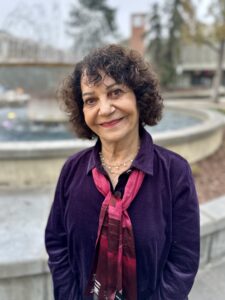
Pauline Sahakian is a retired educator living in Fresno. Over a 50-year career, she taught English composition and Advanced Placement courses in Clovis Unified School District, where she served as the district’s writing assessment and resource teacher, and for a time she taught first-year writing courses as a lecturer at Fresno State.
Then for 18 years, Sahakian served as founding director of the UC Merced Writing Project, where she led summer institutes and year-round professional development programs in the teaching of writing for K-12 teachers. She retired in 2018 at age 74.
Sahakian’s five decades as an educator were sparked by an early-career fellowship she earned with the San Joaquin Valley Writing Project, which led to a decade as the project’s associate director.
She holds a secondary teaching credential and three degrees from Fresno State: bachelor’s degrees in English literature and theatre arts in 1966; a master’s in English composition in 1988; and an Ed.D. in educational leadership, with an emphasis in curriculum and instruction, in 1997, through the then joint doctoral program with UC Davis.
“Fresno State has always provided me with wonderful opportunities for growth,” Sahakian said. “I have always loved school and learning, even as a child, so teaching was a natural career choice for me. But I never had any decent writing instruction until I enrolled at Fresno State.”
Sahakian always believed, from early on in her own learning and teaching, that to be effective she needed to write alongside her students — sharing her own writing as an example, showing all her stumbles and how she worked through them.
In this way, her high school students became her first audience.
“I guess I realized that one does not learn to be a thinker and a writer only from a textbook,” Sahakian said. “So I became a writing teacher who wrote, one with practices I could share with my students, and I wanted to learn more as a writer and teacher of writing.”
Sahakian felt fortunate that Clovis Unified recognized her early energy and expertise. She said they created the new administrative position of Writing Assessment and Resource Teacher for her at the district office.
In this role, she went into K-12 classrooms and conducted weeklong writing lessons while grade-level teachers observed. A discussion of her thinking process, teaching strategies and student guidance and feedback followed each lesson.
“My district realized the importance of encouraging grade-level teachers to collaborate,” Sahakian said, “and they built in time to do this.”
In 1994, Sahakian was named Fresno County Teacher of the Year and was honored as a finalist for California Teacher of the Year.
Sahakian’s pedagogical thinking about the teaching of writing began to greatly expand during her time in the M.A. English program, which she enrolled in nearly 20 years into her teaching career. She said formal university learning “encourages not only depth within a discipline, but an individual’s discipline in depth of learning,” and the outstanding mentors she met in the English Department took a personal interest in encouraging her development.
Although she enjoyed literary analysis and rhetoric, Sahakian said autobiographical writing emerged as her focus. Her master’s thesis became a collection of nonfiction essays exploring her life in Fresno as a first-generation Armenian American. She grew up in a household speaking two languages and navigating two cultures, and that’s what she wrote about and analyzed.
“I became a writer by exploring my heritage,” she said, “and at the same time a better writing teacher for my students.”
Sahakian continues to write nonfiction in retirement. In recent years, her memoir-style essays have appeared in The Fresno Bee’s Valley Voices column and elsewhere.
Always leaning in to lifelong learning, Sahakian continued her development as an educator when she returned to Fresno State at age 50 as a doctoral student. Her interests by then had shifted to English learners, and her dissertation focused on the writing development and strategies of Hmong high school students, navigating the moves from a tonal language that provided no framework or transfer of learning to English.
“We are fortunate to have such a supportive educational institution in our community,” Sahakian said. “Pursuing a higher degree at Fresno State resulted in opportunities for both job enhancement and personal growth in my long career as an educator.”