

Each year, Fresno State faculty shape their fields and share their new ideas and findings through published books.
From groundbreaking research and insightful scholarship to imaginative works of fiction and poetry, their books reflect the depth, diversity and creativity that define Fresno State’s academic community. This year’s collection of faculty publications celebrates not only the pursuit of knowledge but also the stories, questions and discoveries that inspire it.
Here is a list of 2025 books published by Fresno State faculty.
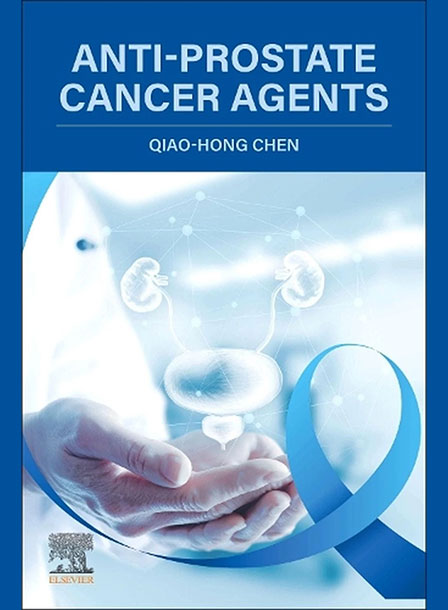
Written by Qiao-Hong Chen, Department of Chemistry and Biochemistry
“Anti-Prostate Cancer Agents” walks readers through the anti-prostate cancer drug development pipeline — from early discovery and design to clinical studies and applications. The book covers the discovery/design process, synthetic studies, preclinical evaluation, mechanisms of action, structure–activity relationships and clinical development of anti-prostate cancer agents. It also highlights how the design and discovery of these agents have evolved from androgen deprivation therapy to the development of modern androgen receptor antagonists and degraders.

Written by Rafael Lemus, Department of Modern and Classical Languages and Literatures
“Atlas of (another) Mexico” invites us to explore an elusive — yet entirely true — map of the places imagined by our literature. Utopian cities. Cursed ranches. Ghost towns. This book is an atlas that serves both to help us find ourselves and to help us get lost. A map that leads us into the labyrinths of creation to show us a broader, more complete, more real image of Mexico.

“Azorean History Themes: Islands of Struggle and Resilience”
Translated by Diniz Borges, Department of Modern and Classical Languages and Literature, and director of the Portuguese Beyond Borders Institute
Azorean History Themes invites readers on a vivid journey through the often-overlooked past of the Azores. Historian Carlos Enes unearths defining moments of resistance, mythmaking and identity across the archipelago — from Terceira Island’s legendary defiance of Spanish rule in the 16th century to the long battles against fascism and the birth of Azorean autonomy in the 20th century. With attention to the voices of artisans, workers and everyday citizens, this book reveals how ordinary people shaped an extraordinary legacy of rebellion, democracy and resilience. Essential reading for anyone seeking to understand the enduring roots and dynamic evolution of the Azorean spirit.

“Decolonizing Environmentalism: Alternative Visions and Practices of Environmental Action”
Written by Prakash Kashwan and Aseem Hasnain, Department of Sociology
We live in a moment rife with mixed emotions — existential anxieties about catastrophic climate change, presumptuous confidence in planet-hacking geoengineering technologies and hopefulness of youth climate activism. “Decolonizing Environmentalism” helps us navigate these emotions and reimagine our approach to environmental stewardship.
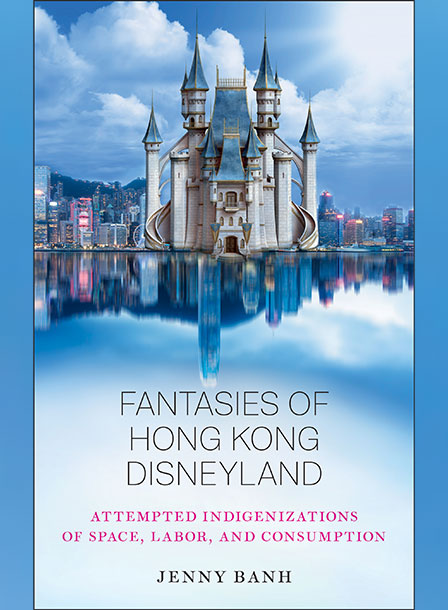
“Fantasies of Hong Kong Disneyland: Attempted Indigenizations of Space, Labor and Consumption”
Written by Jenny Banh, Department of Anthropology, and coordinator of the Asian American Studies Program
“Fantasies of Hong Kong Disneyland: Attempted Indigenizations of Space, Labor, and Consumption” examines the attempt to transplant Disney’s “happiest place on Earth” ethos to Hong Kong — with unhappy results. Focusing on the attempted localization/indigenization of this idea in a globalized, transnational park, the book delves into the three-way dynamics of an American culture-corporation’s intentions, Hong Kong, China’s government investment and Hong Konger audience, and the Hong Kong Chinese locale. The triple actors introduce an especially complex case as two of the world’s most powerful entities, the nominally Communist state of China and corporate behemoth Disney, come together for a project in the third space of Hong Kong. The situation poses special challenges for Disney’s efforts to manage space, labor and consumption to achieve local adaptation and business success. Library copy.
“Foodways in the Twentieth-Century City”
Written by Maria-Aparecida Lopes, Department of Chicano and Latin American Studies, and María Cecilia Zuleta
“Foodways in the Twentieth-Century City” explores a fundamental question through the lens of the modern metropolis: How did the experience of food and eating evolve throughout the 20th century? In answering this query, this element examines significant changes in the production, distribution and consumption of food in cities worldwide. It takes a comprehensive view of foodways, encompassing the material, institutional and sociocultural conditions that shaped food’s journey from farm to table. The work delves into everyday practices like buying, selling, cooking and eating, both at home and in public spaces. Central themes include local and global food governance and food access inequality as urban communities, markets and governments navigated the complex landscape of abundance and scarcity. This element highlights the unique dynamics of urban food supply and consumption over time. Library copy.

“The Gate of Memory: Poems by Descendants of Nikkei Wartime Incarceration”
Edited by Brynn Saito, Department of English, and Brandon Shimoda
A tribute to the 150,000 people incarcerated by the United States and Canada during World War II, this anthology is the first of its kind. With a foreword by acclaimed poet, activist and concentration camp survivor Mitsuye Yamada, and an introduction by the editors, poets Brynn Saito and Brandon Shimoda, “The Gate of Memory” explores intergenerational trauma as the 66 contributors, all of whom are descendants of those who were incarcerated, sift through an intimate record of wartime incarceration. Library copy.

Organized and translated by Diniz Borges, Department of Modern and Classical Languages and Literature, and director of the Portuguese Beyond Borders Institute
Going to the Horizon gives voice to the soul of the Azores and to humanity’s universal longings. With poems rooted in the Azorean basalt and sea mist, this extraordinary collection explores love, exile, injustice, memory and the stubborn hope of those who stay behind or leave searching for something more. This is a testament to poetry’s power to challenge, uplift and remember. It is essential for lovers of insular literature and postcolonial poetics, and those who believe words can still remake the world.
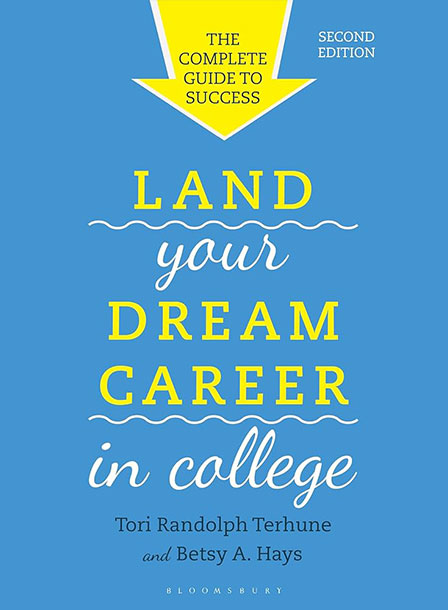
“Land your Dream Career in College: The complete guide to success (Second edition)”
Written by Tori Randolph Terhune and Betsy Hays, Department of Media, Communications and Journalism
Both the college landscape and the world of work have witnessed seismic shifts in the last decade, from the rapid advancement of digital technology to the global reshaping of the workplace caused by the pandemic. Now more than ever, it’s essential for students to consciously shape their college experience as a road to an immediate career. The second edition meets students at the early planning stages for college, assessing interests to find a dream career that’s right for them, understanding the courses they need to take, the internships and opportunities they must seize and the obstacles they’ll encounter. Key to the new edition is a focus on defining your dream career, using the latest tools and resources to build your portfolio of knowledge and experience, and how to pivot if your dreams or realities of life change.

“Managing Recreation, Parks, and Leisure Services: An Introduction (Fifth edition)”
Written by Samuel Lankford, Department of Recreation Administration, Oksana Grybovych Hafermann, Christopher R Edginton, Dale Larsen, and Jody Hironaka-Juteau, Department of Recreation Administration
The authors maintained the basic organization framework and structure for the fifth edition of “Managing Recreation, Parks and Leisure Services: An Introduction.” The book is divided into four sections. Part one is focused on the topic of “Managing Recreation, Parks and Leisure Services: Setting the Context.” Part two presents “Key Managerial Leadership Issues.” Part three offers information focused on “Managing Resources.” And part four offers a review of issues related to “The Future.” Incremental additions have been made in each chapter as needed, and we included a section in every chapter known as Park Features, which provide for classroom discussion.
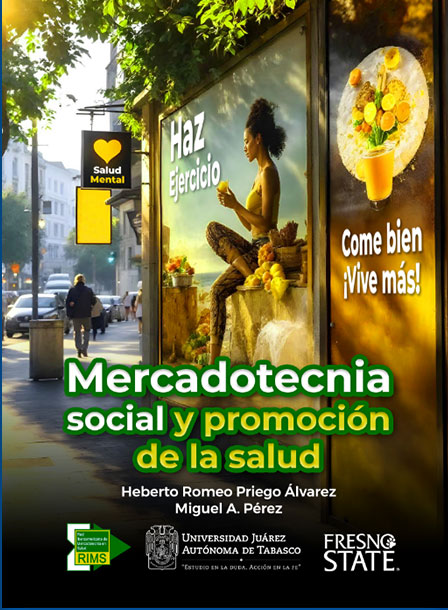
“Mercadotecnia Social y Promoción de la Salud/Social Marketing and Health Promotion”
Edited by Heberto Priego, Universidad Juárez Autónoma de Tabasco, and Miguel A. Pérez, College of Health and Human Services
The purpose of Mercadotecnia Social y Promoción de la Salud is to improve individual and collective well-being through communication and persuasion strategies that influence people’s behaviors and habits in favor of their health. This involves promoting healthy habits, preventing disease and empowering people to take greater control over their health and their environment, thereby creating healthier and more responsible societies.

Written by Negin Tahvildary, Departments of Philosophy and Linguistics, and Karen Sperling
“Peace Talks: The Dragon Egg” is a beautifully illustrated mediation story for children ages 8 to 11 that nurtures social-emotional learning and conflict resolution skills. When Zara, a young dragon rider, believes her cherished dragon egg has been stolen by her friend Pax, the griffin, two magical peer mediators guide them through a peaceful problem-solving process. Using the ground rules (work hard, be honest, don’t interrupt and no put-downs), the story models empathy, active listening, emotional awareness and accountability. Through dialogue, both friends learn to express their feelings, listen to one another and find a fair solution built on trust. The story promotes emotional intelligence by showing children how understanding, kindness and communication can transform conflict into friendship, making it a meaningful teaching tool for classrooms and families alike. Library copy.

“Peace Talks: The Magic Mix-Ups”
Written by Negin Tahvildary, Departments of Philosophy and Linguistics, and Karen Sperling
“Peace Talks: The Magic Mix-Ups” is a charming story designed for children ages 6 to 9 that blends imagination with lessons in social-emotional learning and conflict resolution. Through the story of two friends (a wizard and a witch, who get into an argument over baking cookies), young readers learn how empathy, active listening and cooperation can transform conflict into creativity. Guided by two magical peer mediators, a unicorn and a fairy cat, the characters follow clear ground rules (work hard, honesty, no interruptions and no put-downs) to identify their feelings, listen to each other and collaboratively find a “win–win” solution. The book highlights how communication, emotional awareness and perspective-taking can build peaceful problem-solving skills.

Written by Mai Der Vang, Department of English
“Primordial” is a crucial turn to the ecological and generational impact of violence, a powerful and rousing meditation on climate, origin and fate. With profound and attentive care, Vang addresses the plight of the saola, an extremely rare and critically endangered animal native to the Annamite Mountains in Laos and Vietnam. The saola looks like an antelope, with two long horns, and is related to wild cattle, though the saola has been placed in a genus of its own. Primordial examines the saola’s relationship to Hmong refugee identity and cosmology and a shared sense of exile, precarity, privacy and survival. Can a war-torn landscape and memory provide sanctuary, and what are the consequences for our climate, our origins, our ability to belong to a homeland? Written during a difficult pregnancy and postpartum period, Vang’s poems are urgent stays against extinction. Library copy.

“Raízes e Horizontes — Narrativas da Diáspora Açoriana”
Written by Diniz Borges, Department of Modern and Classical Languages and Literature, and director of the Portuguese Beyond Borders Institute
“Raízes e Horizontes” is a sweeping, intimate portrait of the Azorean diaspora in California, blending memoir, cultural history, literary reflection and civic analysis into a single, cohesive narrative. Drawing on decades of lived experience, community engagement and scholarly observation, the book traces the journey of Azorean emigrants — from the dreams they carried across the ocean to the vibrant açor-californian identity they built in the American West. The book explores the evolution of festivities, language, literature, political participation and transatlantic ties, while arguing for the vital role of cultural memory and translation in connecting new generations to their roots. Raízes e Horizontes offers an understanding of a community shaped by both deep roots and ever-widening horizons.

“Research Handbook on Health Education, Health Promotion and Diversity”
Edited by Raffy R. Luquis and Miguel A. Pérez, College of Health and Human Services
The purpose of the “Research Handbook on Health Education, Health Promotion and Diversity” is to provide researchers with guidance on how to conduct studies that are culturally competent and effective in addressing health disparities among diverse populations. It aims to move beyond traditional, “blind” research methods by advocating for the integration of cultural and linguistic competencies and a deeper understanding of the social determinants of health in research design to achieve health equity.

“Sing me a Circle: Love, loss, and a home in time”
Written by Samina Najmi, Department of English
Winner of the 2024 Aurora Polaris Prize in creative nonfiction, “Sing Me a Circle” is a memoir in essays, written over a span of 10 years. The perspective is that of a Pakistani American woman, now rooted in Fresno, in California’s Central Valley, where her primary identity is that of a professor and a mother of two. Her thoughts on the present and the future reach into a past that spans multiple continents and generations. Like her elders, the author of these essays seeks home in time and on the page. Library copy.
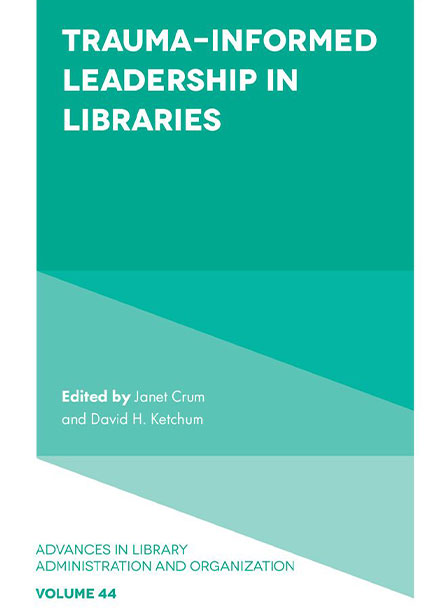
“Trauma-Informed Leadership in Libraries”
Edited by Janet Crum, Fresno State Library, and David Ketchum
Trauma-informed practices have become an increasingly essential part of librarianship since the COVID-19 global pandemic. Trauma can result from a single negative event or repeated exposure to negative events over time and can manifest in many forms. Trauma-informed approaches to leadership seek to understand and consider an individual’s holistic life experiences, particularly negative consequences of trauma, when determining how to best support and interact with them in the workplace. This book includes 11 chapters by library leaders in the U.S. and Canada, discussing practical approaches to implementing trauma-informed leadership practices in libraries.
“Understanding English Structure: A Practical Grammar Guide for Language Teachers”

Written by Chandra Shekar, Department of Linguistics
This textbook invites readers to explore the grammar of English as a system shaped by internal rules, intuitive patterns and cognitive logic. With clear explanations, illustrative tree diagrams and practical examples drawn from real language use, it bridges traditional classroom instruction with modern linguistic insight.
(This list was compiled with help from David Drexler, scholarly communication librarian at the Fresno State Library, and through submissions to Campus News, the university faculty and staff newsletter. It does not reflect all published books this year.)